I want to start there, because it is the reason I am sharing this. I look at the globe on my website, see activity from somewhere in the world, and click. Where is that? What is it like there? Somebody, somewhere, found their way to something I made.
I am inspired by that. Awed by it. Really, truly motivated by it.
When I can see the world—the planet in the universe that we all share—and see connections arriving from all over it, every day, the work feels different. The articles, the code, the videos, the experiments: they are reaching beyond the room where I made them. I do not take that for granted.
There are people behind those dots. There is a whole world beyond my screen.
Before the globe, there was the counter
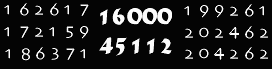
If you made a website in the 1990s, you probably remember the little counter at the bottom of the page. A row of green digits. An odometer. “You are visitor number 000042.”
I love what that small piece of the web was trying to say: somebody was here.
YOU ARE VISITOR NUMBER…
Actual preserved graphics, not recreations: the Nirvana Fan Club museum identifies examples from 1997 and March/April 1998; the additional digit styles come from Muhammad A. Muquit's Count 2.5 documentation, released in 1999. These are examples of the era, not my own old counters.
The number was imperfect. A page view was never the same thing as a person. But there was something personal about seeing evidence that a page had been visited. The counter was part of the page itself, visible to everyone.
I wanted to carry that feeling forward. Keep the joy of somebody being here, and let the experience grow into something you can explore.
That is a deeply personal part of this story. Before I could travel to those places, I could explore them on a computer. I was nine years old, and the world felt enormous. It was something I wanted to know more about.
A computer could let me explore the world. Countries. Maps. Places I had never been. It gave my curiosity somewhere to go.
Looking back, I think it shaped my passion for travel, culture, and humanism deeply. The world became something I wanted to understand. Other places mattered. Other people mattered. There was so much beyond what I already knew.
That feeling stayed with me. A country on a screen could open a door to thinking about people, languages, and ways of living beyond my own. I think that curiosity became part of how I see the world.
Travel, culture, humanism: when I look back at what matters to me now, I can see a little of that nine-year-old at the computer.
Now it is 2026, and I am having that experience again. This time the connection is real. People are finding their way to my little corner of the web from places around the planet. I can turn the globe, click a place, and wonder about the life being lived there.
I do this. I actually click. It is not a feature I put on the homepage and forgot about. Seeing those places, day after day, gives me a reason to write the next article, share the next piece of code, and try the next idea.
We share this planet. For a moment, something I made has become a point of connection with someone else on it. I find that extraordinary.
The location is approximate. An IP estimate cannot tell me who a person is, exactly where they are, or why they visited. VPNs and mobile networks can move a pin. I know that. It does not take away the feeling of connection; it keeps me honest about what the visualization actually shows.
“I click these places. I am curious about them. And I am inspired to keep making things.”
It is the Three.js globe and visitor counter from this website, extracted into its own runnable project. You can rotate it, zoom, select locations, pause the animation, and switch between recent activity, today, and historical aggregates. It comes with the supporting code, a Node collector for local development, a PHP collector for compatible hosting, and the map data. It also includes the finished PC GLOBE experience now live on my site.
The arcs are illustrative connections. They are not traceroutes or measured packet paths. The counter measures page views and browser sessions, not verified individual humans. Historical country totals, current location estimates, geographic landmarks, and fictional examples each have their own meaning and labels.
Try it below. Turn the globe, click a place, and get curious. Choose PC GLOBE to open the retro atlas. In the atlas, use the DATA menu to choose historical reports, Right now, or Today. Both views are also on the homepage and Stats page.
16-bit synth · sound starts only when you press play.
VISITOR DIRECTORY
A little window back to childhood.
A tribute to PC Globe, first released in 1987, with the DOS / early Windows atlas feel and John’s real visitor data. Choose a country for its flag and facts, then play its anthem opening. Two original synth themes accompany the journey.
Drag to pan after zooming. With the map focused, use arrow keys to pan, + / − to zoom, and 0 to see the world. Escape stops audio and closes this panel. Sound also stops when you leave this tab.
250 country and territory profiles; 43 licensed anthem openings. Small islands missing from the overview map are available in the country menu. Historical totals remain country aggregates. Live pins are approximate city / region estimates; unresolved visitors stay unmapped.
The new repository starts your counter at zero. You can supply your own verified historical baseline. My public sample history is included for understanding how the visualization works, clearly separated from your new visits.
You do not need an AI subscription to run it. You do not need my private website repository. Clone it, install the dependencies, and start it locally.
git clone https://github.com/automateyournetwork/hello-planet.git
cd hello-planet
npm ci
npm run dev
Open http://127.0.0.1:4337 with Node.js 24 or newer. The README explains integration, configuration, hosting, and what changes when you move beyond localhost.
The memory became the next feature
While thinking about this article, I said I wanted a PC Globe modality for my counter.
The connection was right there. The software I loved as a child had helped make me curious about the world. The globe on my website was giving me that feeling again. I wanted to bring those experiences together.
And now it is live.
Click PC GLOBE in the globe above. The modern globe gives way to a DOS / early Windows style atlas. Select a country. See its flag, capital, languages, and currency. Change the display from EGA colour to CGA cyan and magenta, or to an amber monitor. Turn the visitor layer on and off. Open the city gazetteer and explore somewhere you have never been.
If you want sound, press play. There are synthesized anthem openings for supported countries, two original themes, and FM or PC-speaker voices. Sound is your choice; it starts when you ask for it.
The country profiles and flags cover 250 countries and territories. The city directory has 503 places. The anthem collection has entries for 43 countries and territories, sharing 36 melodies; places without an included score say so. The credits travel with the data and music.
The atlas can show the same visitor snapshots as the modern globe. A country profile describes a place; the visitor layer shows what the counter actually knows. Those are different things, and the interface keeps that distinction visible.
This is an original tribute with sourced geographic data and music, not the old DOS program running in a browser. What I wanted to bring back was the invitation to explore.
“At nine, I explored a world I wanted to know. In 2026, people from that world are finding their way here.”
JOHN CAPOBIANCO
An idea. A spec. A loop.
The idea came from a memory that mattered to me. The spec made it concrete: a retro atlas, country selection, visitor overlays, keyboard access, optional sound, and clear sources. The loops made it something we could run, inspect, test, and improve. Now you can try the result yourself.
That is the part I want you to take away. An idea does not have to begin as a product roadmap. It can begin with something you loved at nine years old. Write down what you want to recover from that feeling, describe how it should work, and start building.
We are sharing how we did this, too
My website used to be WordPress. The rebuild started with the content and the things worth preserving: the writing, the URLs people had linked to, the images, the books, the discussion, the history.
The new site uses Astro for the pages and Three.js for experiences like this globe. Public content was recovered into a build pipeline. New writing lives in Markdown. Search, feeds, navigation, and redirects had to work. The old site needed to remain recoverable. The result keeps growing because it is something I can work on and understand.
Hello, Planet shares the method alongside the component:
How to integrate the globe into an Astro site, or display a self-hosted embed in another website.
How to approach a WordPress migration, including content inventories, media recovery, old URLs, staging, and rollback.
How to prompt a coding agent with evidence, constraints, and acceptance criteria.
How to use a harness that can read the project, run the app, check behavior, and inspect the browser.
How to work in loops that end with evidence and a usable handoff.
The “secrets” are here in the README and guides: preserve intent, give the agent good context, specify the behavior, and inspect what comes back. My actual hosting credentials and visitor databases stay private. The process is yours to use.
An atlas for a classroom. A travel journal. An opt-in community map where people share a place that matters to them. A globe that replays the history of your project. A view of Earth that opens out into the solar system.
Those are possibilities, not features I am claiming to have shipped. They are invitations.
Fork this. Change the colors. Move the home pin. Replace the backend. Make it quieter, stranger, more useful, more you. Write down what you want it to do, give it a loop, and see what happens.
And if you are one of the people visiting from somewhere out there: thank you. I see a little more of the world because you came here. You are helping inspire the next thing I make.
 John Capobianco ·


 John · Val-des-MontsAbout John ↗