Backbone
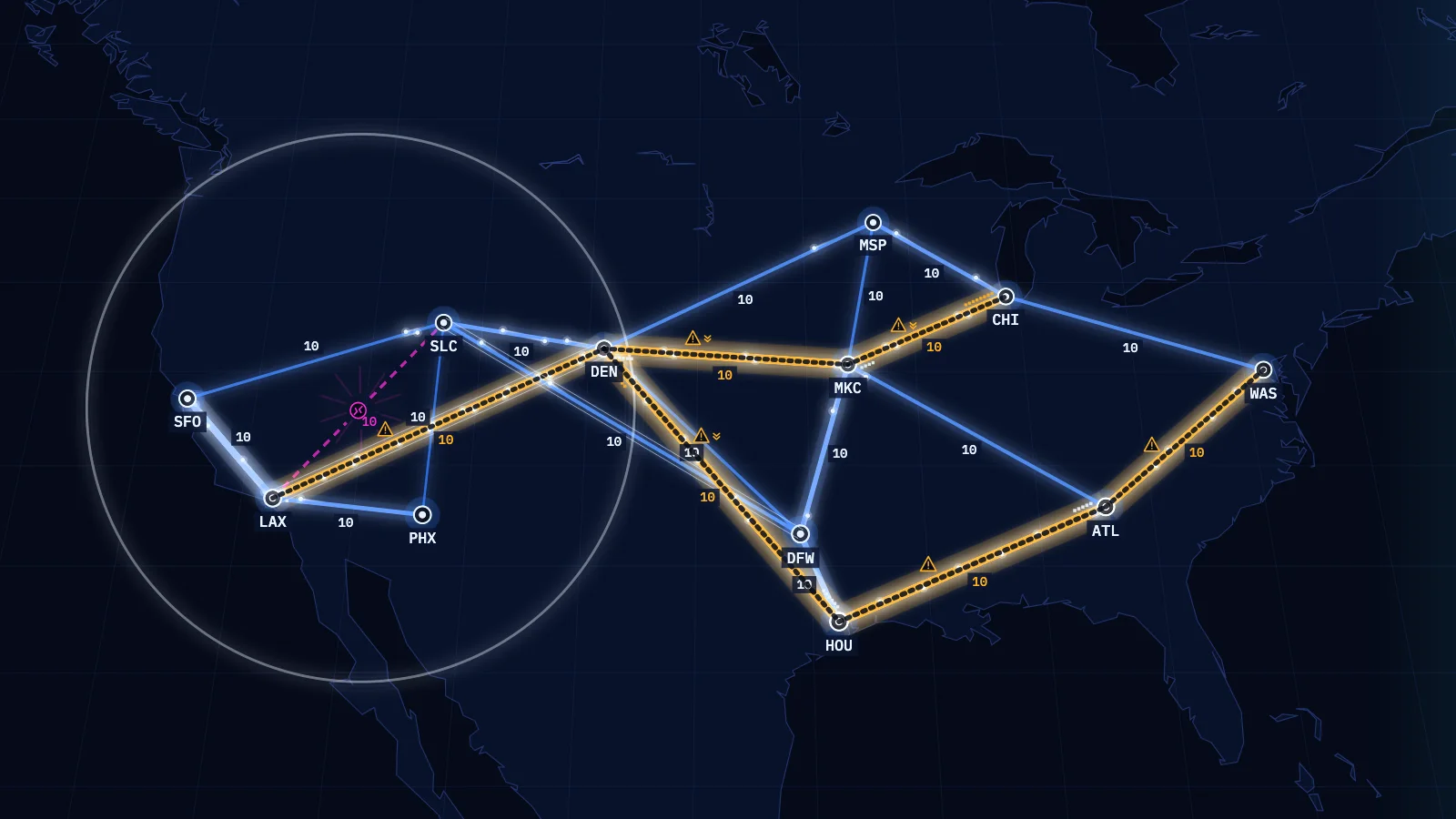
The player lays fiber between cities, sets link costs and upgrades capacity while every packet follows OSPF's lowest-cost path. Overloaded links drop packets and fiber cuts force reconvergence, so the player learns to predict where load moves when the network changes.
The builder
- Name
- Elliot Conner
- First spec project?
- No
- Began at
- NAF AC6
How it was built
- Model
- claude-fable-5-2+ code-review skill reviewers: three forked sessions of claude-fable-5-2, the same model
- Harness
- Claude Code 2.1.322
- Spec method
- GitHub Spec Kit 1.2.2
- Spec artifacts
- constitution, spec, clarify, plan, tasks, analysis, checklists
- Tasks
- 70 in 9 loops
- Human prompts
- 19
Build environment
- MCP servers
- None was called. Connected but unused: claude-in-chrome, MCP_DOCKER, claude.ai Claude Docs, claude.ai Gmail / Google Calendar / Google Drive (auth stubs), ide, pycharm, itential-docs, nautobot-ashburn, nautobot-charlotte, netbox_mcp
- Sources & RAG
- The owner's three approved input files in StarterKit/ (constitution, spec, plan)
- RFC 2328 (OSPF Version 2) text from rfc-editor.org, sections 16.1, 16.1.1, 16.8, 13.2, 9.2, A.4.2, C.3
- RFC 2991, searched for its statements on reordering and hashing
- NAF_AC6 workshop repo at commit b77da71: lab guide, StarterKit README, ARCADE.md template and the Per-Hop Works example
- The Arcade page at automateyournetwork.com/arcade and its ARCADE.md template
- Natural Earth v5.1.2: populated places 1:10m, land and lakes 1:50m (map data)
- FRR 10.7.1 as a reference OSPF implementation
- The approved visual mock in mock/
- Skills
- GitHub Spec Kit commands as Claude Code skills: speckit-constitution, speckit-specify, speckit-clarify, speckit-plan, speckit-tasks, speckit-analyze, speckit-implement
- secure-build-standard (owner's skill)
- code-review (Claude Code skill)
- Owner's Claude Code hooks: ruff on Python edits (seen to run), disk warning, code-review gate
- Other tools
- TypeScript 7.0.2
- Vite 8.3.7
- Vitest 5.1.0
- Playwright 1.65.0 with Chromium headless shell 158.0.8127.18
- Node v26.3.1
- Python 3.15.0
- Docker 29.9.1
- ffmpeg 8.0.1
- cwebp 1.6.0
- ruff
- gitleaks 8.30.1
- curl
- git
- AI assets
- All game code, CSS, markup, tests and tools: written by the build agent (claude-fable-5-2)
- Hero and card image: a frame rendered by the game's own WebGL renderer, captured with Playwright; no image generator
- Audio: none
- 3D models: none
Runtime: how to play
- Type
- static-web · HTML, CSS, TypeScript, WebGL2 with a Canvas 2D fallback, no runtime dependencies
- Start
- python3 -m http.server 8791 --bind 127.0.0.1 --directory dist
- Then open
- http://127.0.0.1:8791
- Install needed
- No
- Internet needed
- No
- API key needed
- No
- AI at runtime
- No
- Tested on
- Chromium headless shell 158 (Playwright)
- Saves
- browser localStorage (five best scores and the reduced-motion setting)
- Accessibility
- Tested by automation in Chromium only: keyboard-only play with visible focus at desktop size; touch at phone size; reduced motion; play without WebGL in the Canvas 2D fallback; no green or red in authored colors, and zero pixels in either band in screenshots of both renderers; text contrast at least 4.5 to 1; every control named. Not tested by the build: a person playing, screen readers, a real phone, Safari, Firefox. The owner reports playing in a web browser for about 6 or 7 minutes and on an iPhone 17 Pro, where he says it feels smooth; the browsers were not named and nothing was measured.
Verification
- Tests
- 198 passing · npm test && npm run build && npm run verify:dist && npm run test:e2e
- Facts from
- RFC 2328, RFC 2991
- Known limits
- Single area, point-to-point links, one router per site
- Convergence is instant: no hello or dead timers, flooding delay or micro-loops
- One cost per link for both directions
- Each router keeps one equal-cost route in v1; ties go to the lowest router ID
- Fixed-size packets, fixed-rate queue with tail drop, no TCP or QoS
- Capacity upgrades do not change cost
- Only links fail
- Play by a person rests on the owner's own report (a web browser for about 6 or 7 minutes; an iPhone 17 Pro), which the build did not observe, time or measure; frame rate on a mid-range phone was not measured
- Verified in Chromium only
- License
- Apache-2.0
Who it is for.
Backbone is a network-building game for working network engineers. You lay fiber between cities on a dark map, set link costs and upgrade capacity, and the traffic routes itself along OSPF's lowest-cost paths. You never steer a packet. It is for anyone who has tuned a metric to fix one path and then been surprised by where the rest of the traffic went.
THE BUILD STORYHow it was made.
The game was first hand-built from a constitution, specification and plan in the workshop's StarterKit shape. The owner then asked for it to be rebuilt the way the lab teaches: those three approved files became the inputs, and GitHub Spec Kit's seven commands were run in order. The constitution step carried the seven principles over and flagged five conflicts, which the owner decided. He then asked for the other six steps to run unattended. Specify kept the 23 acceptance criteria and added three. Clarify asked five questions, which the agent answered from the owner's approved decisions and marked for his review. Plan resolved ten contradictions in the open. Tasks put the simulation first, with tests before code. Analyze found fifteen inconsistencies, one critical, all fixed before any code. Implement wrote the code anew; nothing was copied from the hand-built version.
What broke: the first end-to-end run tested the wrong game, because an old server on the same port still served the hand-built version. On a phone, tapping a link also pressed a button in the panel that opened under the finger. The first color census found a few dozen green and red pixels where cyan met amber; removing cyan from everything that touches a link brought it to zero. Three code reviews then found thirty faults, among them changes made during a reward choice that were announced but not applied, and two of the first review's own fixes. Twenty-seven were fixed; three were left and recorded.
ADVICEFor the next builder.
- Write the routing cases by hand before the engine exists, then check them twice: against a brute-force oracle and against a real router.
- Measure what the player sees, not what you wrote. "No green, no red" held in the palette and still failed on screenshots, where blending made colors nobody chose.
- Start your own test server on a free port and check what answers. Ours once tested an older build that was still running on the same port.
Built a game of your own?
Fill in the ARCADE template with your build agent and send me your GitHub URL.
Add your game →