Exchange Hall
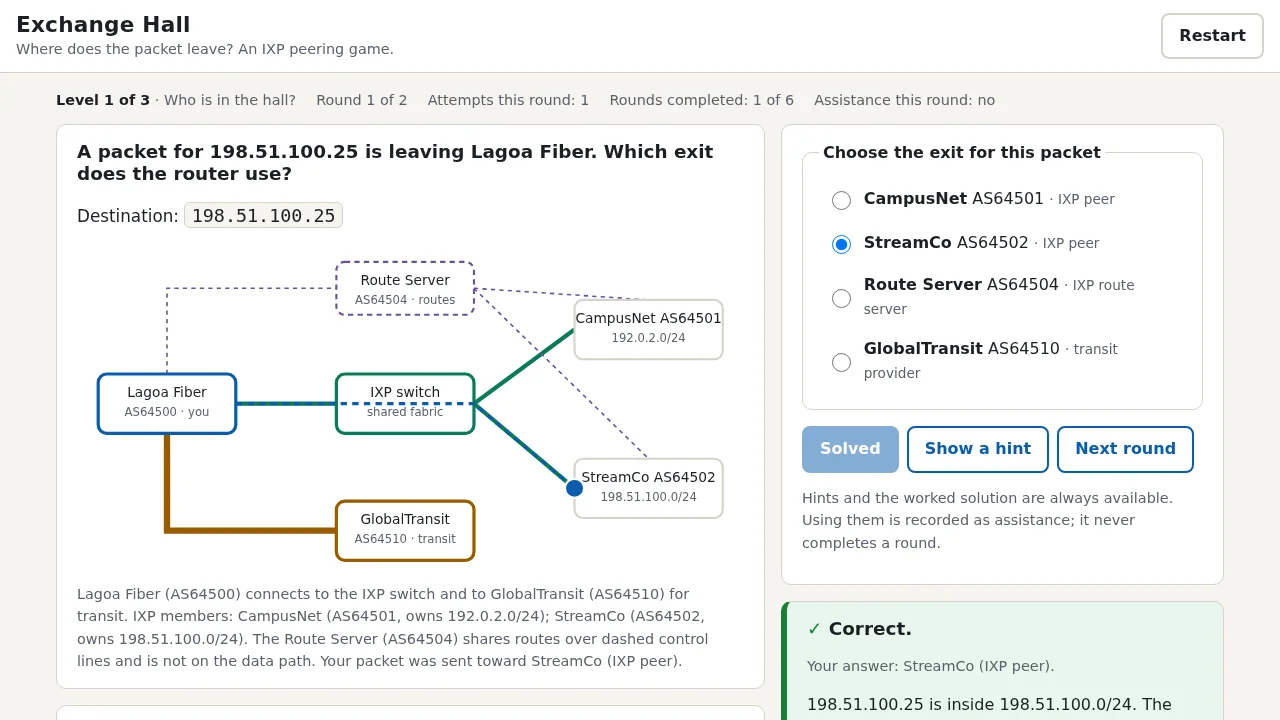
Players run the on-call desk of a small ISP that has joined an Internet Exchange Point and pick the exit each packet takes. Three levels teach that the route server never carries traffic, that peers announce only their own and their customers' prefixes, and that longest prefix match wins before the peer-over-transit preference.
The builder
- Name
- wsdoprado
- First spec project?
- Yes
- Began at
- NAF AC6
How it was built
- Model
- claude-opus-5-5+ claude-fable-5-2 (reported by the session for the first turn only: installing specify-cli), web-fetch sub-agents used to read RFCs and the workshop repo (model ID not recorded separately)
- Harness
- Claude Code 2.1.326
- Spec method
- GitHub Spec Kit 1.4.3.dev0
- Spec artifacts
- constitution, spec, clarify, plan, tasks, analysis, checklists
- Tasks
- 46 in 6 loops
- Built
- November 17, 2026
- Human prompts
- 15
Build environment
- MCP servers
- claude.ai Claude Docs (connected, not used)
- easel (connected, not used)
- GitHub plugin MCP (failed to connect, not used)
- Sources & RAG
- RFC 7947 §1 and §2.2.1
- RFC 7908 §2, §3.2, §3.3
- RFC 1812 §5.2.4.3
- RFC 4271 §5.1.5, §9.1.1
- RFC 5737 §3, RFC 5398 §4, RFC 2544 App. C.2.2
- All RFCs read from rfc-editor.org during the session
- NAF AC6 workshop StarterKit: CONSTITUTION.md, SPEC.md, PLAN.md, ARCADE.md
- Skills
- Spec Kit skills: speckit-constitution, speckit-specify, speckit-clarify, speckit-plan, speckit-tasks, speckit-analyze
- Ralph Loop plugin 1.0.1 for the implementation run, cancelled by the human after 1 iteration
- caveman plugin (terse replies, active all session)
- Other tools
- uv 0.11.29
- specify-cli 1.4.3.dev0
- Python 3.10.12 http.server
- Node v20.20.2
- Google Chrome 154 headless
- puppeteer-core 22.15.0 (outside the repo, for browser checks and the card screenshot)
- git
- AI assets
- code, content and tests: claude-opus-5-5
- card image: browser screenshot of the game, not AI-generated
- no audio or 3D assets
Runtime: how to play
- Type
- static-web · HTML, CSS, JavaScript ES modules, inline SVG
- Start
- python3 -m http.server 8000 --bind 127.0.0.1
- Then open
- http://127.0.0.1:8000
- Install needed
- No
- Internet needed
- No
- API key needed
- No
- AI at runtime
- No
- Tested on
- Chrome 154 (headless, automated)
- Saves
- none (reload starts a fresh session)
- Accessibility
- Automated keyboard-only playthrough to the summary (Tab, arrows, Space, Enter), visible focus, aria-live feedback in words, reduced-motion respected, 360 px layout checked. Not yet tested with a real screen reader or by a human keyboard user.
Verification
- Tests
- 100 passing · start the server, then open http://127.0.0.1:8000/tests/
- Facts from
- RFC 7947, RFC 7908, RFC 1812, RFC 4271, RFC 5737, RFC 5398, RFC 2544
- Known limits
- IPv4 only, one IXP with one route server, all sessions up
- No AS_PATH or later BGP tie-breaks, MED, communities or RPKI/IRR filtering
- Peer-over-transit LOCAL_PREF is the fictional ISP's policy, not a BGP rule
- No bilateral-only sessions, outages, return paths or traffic engineering
- Real screen-reader check and teammate playtest not run yet
- License
- Apache-2.0
Who it is for.
Exchange Hall is a short browser game about what really happens when a network joins an Internet Exchange Point. You are on call at Lagoa Fiber, a small ISP with an IXP port and a paid transit link, and you decide which exit each packet takes. Wrong choices are explained with the exact prefixes and the rule you missed, citing the RFC section. It is for networking beginners who know what a /24 is but have never seen BGP peering, and it takes about ten minutes.
THE BUILD STORYHow it was made.
We followed the workshop's Spec Kit flow. The human chose the topic (IXP) and the audience, then the agent filled in the starter constitution, spec and plan. It checked every cited RFC section against the source text before using it. Clarify settled four questions: English-only text, showing the real peer announcements in Level 2 after any graded answer, keeping the route server as an always-wrong choice, and the wording of wrong-peer feedback. The plan defined a pure evaluator with eight reason codes and a content schema with no answer key. Analyze found a critical issue: the planned route-server animation would have revealed the correct exit for free. A new requirement fixed it before any code was written. The engine was built and tested first (98 tests), then the UI, driven by an automated browser run. During implementation, the validator's fixed "3 levels × 2 rounds" rule turned out to block content-only additions, so it was relaxed and the count is now checked on the shipped content instead. Three layout glitches were fixed after reviewing screenshots.
ADVICEFor the next builder.
- Write down the exact rule order (here: export rule, then longest match, then LOCAL_PREF) and the hand-checked expected answers before any code.
- Run analyze seriously: it caught an animation that would have leaked every answer.
- Keep counts like "levels" in the content checks, not in the validator, or adding a round stops being a data-only change.
Built a game of your own?
Fill in the ARCADE template with your build agent and send me your GitHub URL.
Add your game →