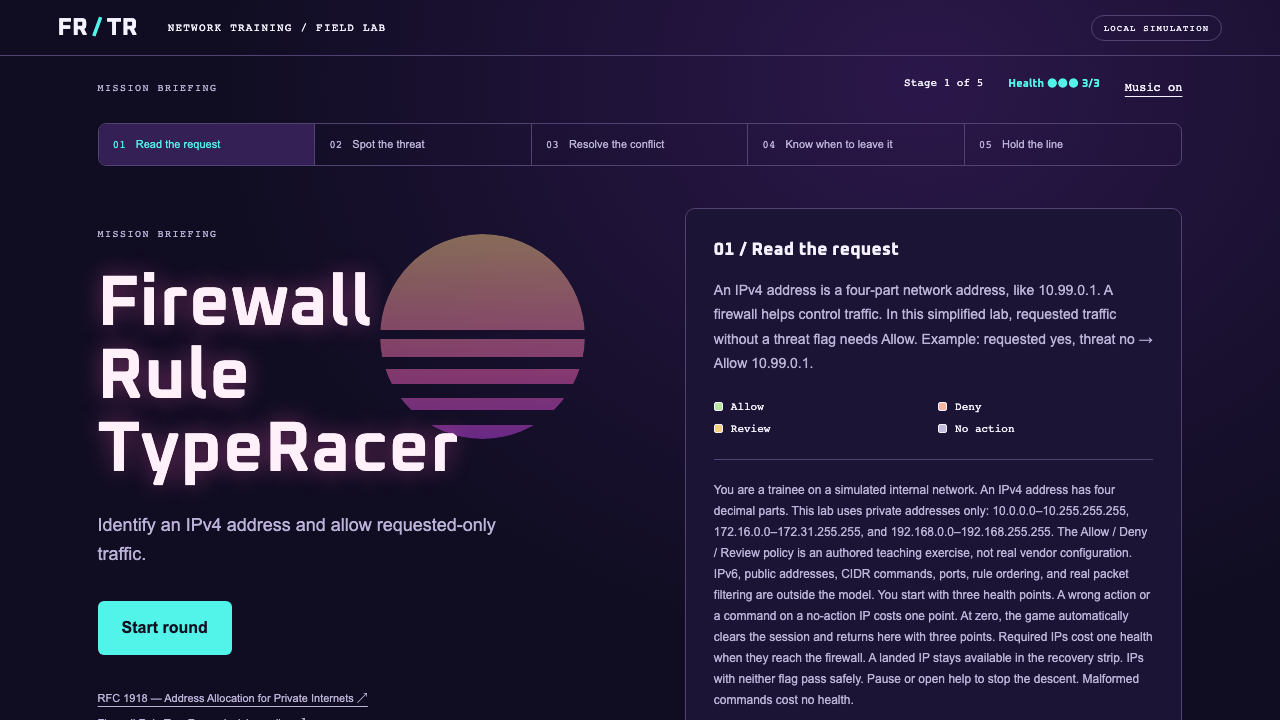
Firewall Rule TypeRacer
Read the request and threat flags on falling private IPv4 addresses. Type Allow, Deny, or Review when a rule is needed, then see how long you can keep up in the endless finale.
The builder
- Name
- thelinoperez
- First spec project?
- Not recorded
- Began at
- NAF AC6
How it was built
- Model
- gpt-6.2-sol+ unknown
- Harness
- Codex
- Spec method
- GitHub Spec Kit
- Spec artifacts
- constitution, spec, plan, tasks, checklists, research, data-model, contracts, quickstart
- Tasks
- 6 in 3 loops
- Built
- November 17, 2026
Build environment
- MCP servers
- mcp__node_repl
- mcp__cua_repl
- Sources & RAG
- StarterKit/CONSTITUTION.md
- StarterKit/SPEC.md
- StarterKit/PLAN.md
- .specify/memory/constitution.md
- specs/001-firewall-rule-typeracer/
- specs/002-synthwave-arcade/
- specs/003-endless-finale/
- specs/004-single-round-stages/
- README.md
- docs/verification.md
- https://www.rfc-editor.org/rfc/rfc1918.html#section-3
- https://github.com/google/fonts/tree/main/ofl/oxanium
- https://github.com/google/fonts/tree/main/ofl/sharetechmono
- Skills
- speckit-constitution
- speckit-specify
- speckit-clarify
- speckit-plan
- speckit-tasks
- speckit-analyze
- speckit-implement
- sites:sites
- unified-computer-use
- Other tools
- Python 3.10.5 http.server
- Git
- curl
- ripgrep
- browser test runner
- Node.js VM module runner
- web.run
- Chrome and DevTools
- Firefox
- Safari
- AI assets
- audio: original 172 BPM chiptune composition and Web Audio synthesis code by Codex
Runtime: how to play
- Type
- static-web · HTML, CSS, JavaScript ES modules, JSON, Web Audio API, Bundled Oxanium and Share Tech Mono
- Start
- python3 -m http.server 8002 --bind 127.0.0.1
- Then open
- http://127.0.0.1:8002/
- Install needed
- No
- Internet needed
- No
- API key needed
- No
- AI at runtime
- No
- Tested on
- Chrome, Firefox, Safari
- Saves
- None. Game progress and music preference live in page memory.
- Accessibility
- Keyboard Start and typing exercised. Earlier builds also had a keyboard-only full run and narrow-viewport and reduced-motion browser checks. Spoken screen-reader feedback and real-phone keyboard and touch playback remain unverified.
Verification
- Tests
- 388 passing · Start the static server and open http://127.0.0.1:8002/tests/ in a browser.
- Facts from
- RFC 1918 section 3 for the three private IPv4 ranges, Authored four-row decision policy in specs/001-firewall-rule-typeracer/spec.md
- Known limits
- Individual RFC 1918 IPv4 addresses only.
- The request and threat flags are authored teaching inputs.
- No IPv6, public IPv4, CIDR commands, ports, vendor syntax, rule ordering, or live packet filtering.
- First-time learner pilot, full-speed manual finale, spoken screen-reader checks, physical touch testing, and audible loop-quality checks remain open.
- License
- unknown
Who it is for.
Firewall Rule TypeRacer is a synthwave typing game for beginners learning how to read and apply simple firewall rules. Check the request and threat flags on each falling IP, then type the matching command or let an IP with neither flag pass. Four short stages introduce the decision table and the fifth keeps sending traffic at an increasing pace. The game uses private IPv4 addresses and a simplified policy for practice.
THE BUILD STORYHow it was made.
We started with the NAF AC6 StarterKit constitution, specification, and plan. We ratified a project constitution, drafted and clarified the specification, then aligned the plan and task list in a consistency review. The original implementation ran through three build and verification loops. The owner then asked for a synthwave playfield with falling IPs and health penalties, an endless finale and soundtrack, and finally one round per stage with the music on by default. The implementation used Codex with the reported model ID `gpt-6.2-sol`. Later handoff planning turns reported `gpt-6.2-astra`. Research helpers also participated, and their model IDs are unknown.
A command parser test exposed inherited property names being accepted as actions. We fixed action lookup to recognize only explicitly declared commands. We added independent expected outcomes for the authored rounds and used a fake clock to test descent, pauses, and finale acceleration. The current task list contains six items. The original implementation list contains 66. The final browser suite passed 388 checks in Chrome, Firefox, and Safari. We ran stage one again for this submission, completed both commands with full health, and observed Chrome indicate audio playback after Start.
ADVICEFor the next builder.
- Record correct and wrong answers independently for every shipped IP. Keep RFC 1918 address-range claims separate from the game's authored decision policy.
- Test a reused finale address against an old landing event. Run the clock through pauses and full lanes before tuning the traffic cadence.
- Verify the first Start gesture in actual browsers. Record browser playback indicators and listening results independently.
Built a game of your own?
Fill in the ARCADE template with your build agent and send me your GitHub URL.
Add your game →