NetMaul: Defend the Datacenter
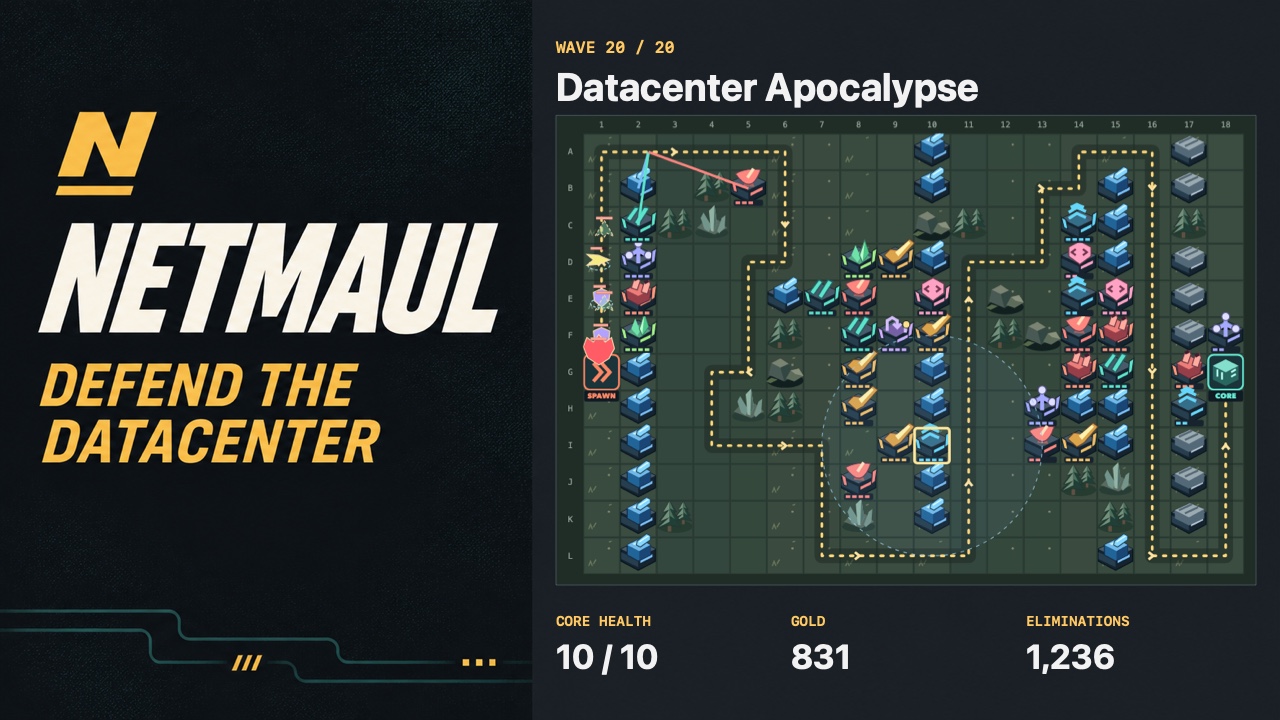
Build a maze from networking equipment and defend the datacenter across 20 waves. Learn how path length, tower placement and equipment matchups change the outcome, with an optional field guide to the networking ideas behind the names.
The builder
- Name
- Trevor Patch
- First spec project?
- Yes
- Began at
- NAF AC6
- Links
How it was built
- Model
- gpt-6.2-astra+ gpt-6.2-sol, codex-auto-review
- Harness
- OpenAI Codex for VS Code 0.169.0-alpha.11.1
- Spec method
- GitHub Spec Kit 1.4.2.dev0
- Spec artifacts
- constitution, spec, clarify, plan, tasks, checklists
- Tasks
- 11 in 5 loops
- Built
- November 17, 2026 · 5h 03m 40s
- Human prompts
- 20
Build environment
- MCP servers
- None recorded
- Sources & RAG
- Local Python/SQLite FTS5 networking index
- RFC Editor IPv4, CIDR and DiffServ publications
- Cisco IOS XE routing and congestion management guides
- Cisco IP access lists and Catalyst 9300 security and QoS guides
- NAF AC6 workshop StarterKit
- Skills
- skill-creator
- netmaul-network-research
- speckit-constitution
- speckit-specify
- speckit-clarify
- speckit-plan
- speckit-tasks
- speckit-analyze
- speckit-implement
- imagegen (Arcade card)
- Other tools
- Git
- Codex web search
- Python unittest and http.server
- Node.js test runner and offline score renderer
- Chrome DevTools Protocol
- macOS afconvert
- WebKit audio decoder
- ImageGen, Swift/CoreGraphics and ImageIO for the Arcade card
- AI assets
- Code-authored SVG battlefield, equipment, enemies and menu artwork
- 20 original 16-bar electronic scores synthesized offline and encoded as stereo AAC
- ImageGen title artwork paired with a screenshot of the running game for the Arcade card
Runtime: how to play
- Type
- static-web · HTML, CSS, Vanilla JavaScript ES modules, SVG, HTML audio with AAC
- Start
- python3 -m http.server 8000 --bind 127.0.0.1
- Then open
- http://127.0.0.1:8000/
- Install needed
- No
- Internet needed
- No
- API key needed
- No
- AI at runtime
- No
- Tested on
- Google Chrome 157.0.8103.79 on macOS (headless)
- Saves
- Music volume and mute persist in localStorage. Campaign state and retry checkpoints last until reload or session reset.
- Accessibility
- Chrome automation exercised keyboard controls, focus, a 360 CSS-pixel viewport and reduced motion. Screen-reader speech and physical touch remain untested.
Verification
- Tests
- 62 passing · node --input-type=module -e "import {runSuites,suites} from './tests/test-runner.js';process.exitCode=Number((await runSuites(suites)).some(t=>!t.passed))" && python3 -m unittest discover -s docs/network-standards -p 'test_*.py' && node tests/browser-playthrough.mjs
- Facts from
- RFC 791, 1812 and 4632, RFC 2474, 2475, 3246, 2597, 3168 and 3260, Cisco Configure IP Access Lists, Cisco Catalyst 9300 IOS XE Dublin 17.12.x IPv4 ACL and QoS guides, Cisco IOS XE 17.x static routing and congestion management guides
- Known limits
- Maze paths, weapons, tier bonuses and damage are fictional game rules. The campaign prioritizes tower defense.
- Nine minutes covers reference combat at normal speed. Building, reading, pauses and retries add player time. Human completion time is unknown.
- One automated winning build verified. Human difficulty, physical speakers, full Safari and Firefox playthroughs, touch and screen-reader speech are untested.
- License
- Apache-2.0
- Tokens
- 67,040,871 in · 253,678 outunknown; measured parent-session counts stop at the last usage snapshot before the game release commit
Who it is for.
NetMaul brings the switchback mazes of mid-2000s Warcraft III Battle.net Wintermaul to a datacenter under siege. Leave one passage open, then put your best equipment where the same enemy will pass it twice. Across seven chapters, four bosses and twenty original electronic tracks, you decide when to extend the maze and when to spend your gold upgrading a tower. Anyone who enjoys tower defense can play, and curious players can open the field guide to see where the network terminology comes from.
THE BUILD STORYHow it was made.
We started with a small index of RFCs and Cisco guides, then used GitHub Spec Kit to write a constitution and feature specification, clarify decisions, and prepare a plan and task list. A requirements checklist and two analysis reviews helped us catch conflicting rules before implementing the first routing, security and QoS simulator. It could grade a packet trace, but Trevor’s feedback was that configuring a network took too much effort and building it was too little fun.
We kept that version playable and built the campaign around the part Trevor remembered from Wintermaul: shaping the route so several towers can hit the same enemy on successive bends. His play feedback drove four equipment tiers, a main menu, wave briefings, the expansion to twenty waves and an original score for each encounter. When an armed purchase got in the way of selecting a tower, we made an occupied tile open its inspector and exercised that interaction in Chrome. The field guide carries the networking context. Weapon damage and tower-built walls follow game rules. A recorded sequence of purchases now plays the whole campaign through the same controls a player uses.
ADVICEFor the next builder.
- Put the first maze in a player’s hands early. Watching someone try to select a tower with a purchase armed exposed a problem that a passing combat test missed.
- Keep a winning shopping list with exact cells and upgrades. Replay it against live combat whenever prices, enemies or rewards change.
- Test the deployed soundtrack as well as the local score. Fetch every track under the repository URL and exercise playback, pause and mute in a browser.
Built a game of your own?
Fill in the ARCADE template with your build agent and send me your GitHub URL.
Add your game →