Packet Dash
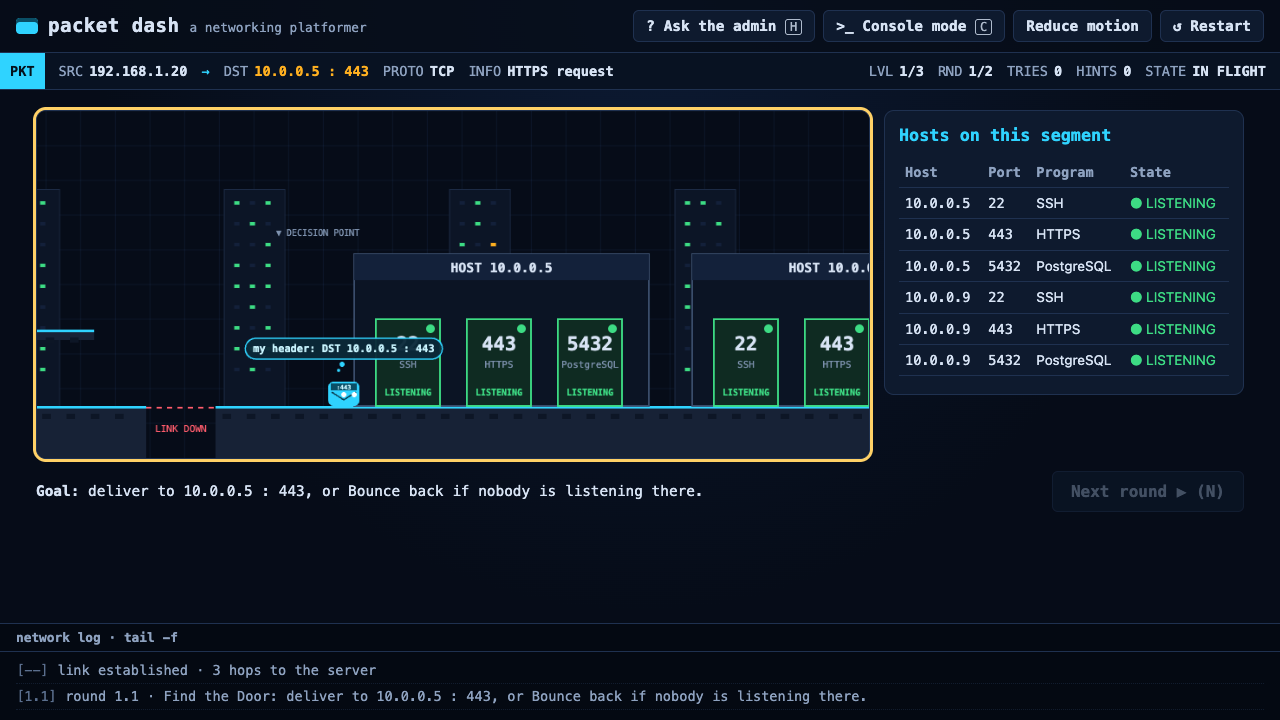
Players run and jump as Pak, a data packet crossing the network, and at the end of each stretch make one delivery decision: which building and door (IP address and port), which path (latency vs bandwidth), which numbered pieces to resend. Each choice is explained in a network log, and after each level a news card links the idea to the November 2026 FAA ground stop and Chase outage.
The builder
- Name
- bharadwajbb
- First spec project?
- Yes
- Began at
- NAF AC6
How it was built
- Model
- claude-opus-5-5
- Harness
- Claude Code 2.1.326
- Spec method
- GitHub Spec Kit 1.4.2.dev0
- Spec artifacts
- constitution, spec, clarify, plan, tasks, analysis, verification
- Tasks
- 29 in 8 loops
- Built
- November 17, 2026
- Human prompts
- 11
Build environment
- MCP servers
- Blender MCP (connected, not used)
- Claude Docs (connected, not used)
- Microsoft 365 (connected, not used)
- RFC MCP (configured, failed to connect)
- Sources & RAG
- RFC 9293 §3.4 and §3.5.2 (fetched from rfc-editor.org)
- RFC 2018 §3 and §5 (fetched from rfc-editor.org)
- IANA Service Name and Port Number Registry (cited)
- Kurose & Ross, Computer Networking §1.4 (cited, not fetched)
- Scripps News, Al Jazeera and CNN reporting on the Nov 13 FAA ground stop and Nov 16 Chase outage (web search and fetch)
- NAF AC6 StarterKit templates and lab guide
- Skills
- Spec Kit project scaffold via `specify init --integration claude`; the /speckit-* commands were not invoked, the agent wrote each artifact by hand in the same order
- Other tools
- Node.js 22.21.1 test runner
- Python 3.11.7
- puppeteer-core 23.11.1 driving Google Chrome 157 headless for playtests and screenshots
- Git
- GitHub CLI
- uv
- web search and fetch
- AI assets
- visuals: drawn in canvas and CSS code written by the agent; no image, audio or model assets
- screenshots: captured from the running game
Runtime: how to play
- Type
- static-web · HTML, CSS, JavaScript ES modules, Canvas 2D
- Start
- python3 start.py
- Then open
- http://127.0.0.1:8000
- Install needed
- No
- Internet needed
- No
- API key needed
- No
- AI at runtime
- No
- Tested on
- Chrome 157 (headless)
- Saves
- In-memory only; reloading starts a new session.
- Accessibility
- Automated keyboard-only playthrough of the link test and all six rounds in platform mode and Console mode (choices as buttons, no jumping); OS reduced-motion preference and toggle checked; 390px-wide layout has no horizontal scroll. No screen-reader test and no human keyboard-only run recorded.
Verification
- Tests
- 46 passing · npm test
- Facts from
- RFC 9293, RFC 2018, IANA port registry, Kurose & Ross §1.4, news articles linked in data/levels.json
- Known limits
- Simplified model of one IPv4 packet, one TCP-style connection and one one-way trip: no handshakes, routing, DNS, firewalls, NAT, congestion, queueing, TCP windows or real timing.
- Level 2 counts only travel time plus size ÷ bandwidth.
- News cards reflect reporting as of Nov 17, 2026; investigations may change details.
- No screen-reader test or second-person source review yet.
- License
- Apache-2.0
Who it is for.
Packet Dash is a short browser platformer for software engineers and other technical people who use networks every day but never studied them. You play Pak, a packet travelling from a laptop to a server: run along the cable trays, jump the dropped links, then make one delivery decision per round. Pick a building and door to learn that the IP address picks the machine and the port picks the program, race a copper tunnel against a fibre trunk to see that bandwidth isn't the only thing that sets speed, and resend exactly the missing numbered pieces. Each level ends with a news card tying the idea to that week's FAA ground stop or Chase outage.
THE BUILD STORYHow it was made.
Setup came first: Spec Kit was installed and initialised with the Claude integration in a new local repository with the StarterKit files. The human rejected the idea menu, then asked for ideas that need no networking background (they are a software engineer), then asked for "something like a Mario but with networking theme". We made it an original platformer instead of a copy and wrote the spec around three beginner ideas. The human asked for the UI itself to look like networking, so the header bar, topology map, terminal log, port doors and receiver board all show real values. We then wrote the constitution, clarified decisions, plan, tasks and analysis, and built the pure rules engine and hand-checked tests before any UI. Analysis caught a missing Bounce back pad in round 1.1 and a message that didn't split evenly into six pieces. The outage cards were added at the human's request, sourced from published reporting. After a first playable version, the human said the instructions should be interactive, so text controls were replaced by a practice "link test" with floating keys and first-round prompts. Every round was played in headless Chrome before each commit.
ADVICEFor the next builder.
- Make the platformer and the accessible mode two views of one list of choices, each carrying the evaluator's answer object, so they can never disagree.
- Write the expected answers by hand before the evaluator exists. It found a tie case and a bad message length early.
- Drive the real browser with key presses before calling it done. It's how we confirmed the gaps were jumpable and the prompts didn't overlap labels.
Built a game of your own?
Fill in the ARCADE template with your build agent and send me your GitHub URL.
Add your game →