Peering Patrol
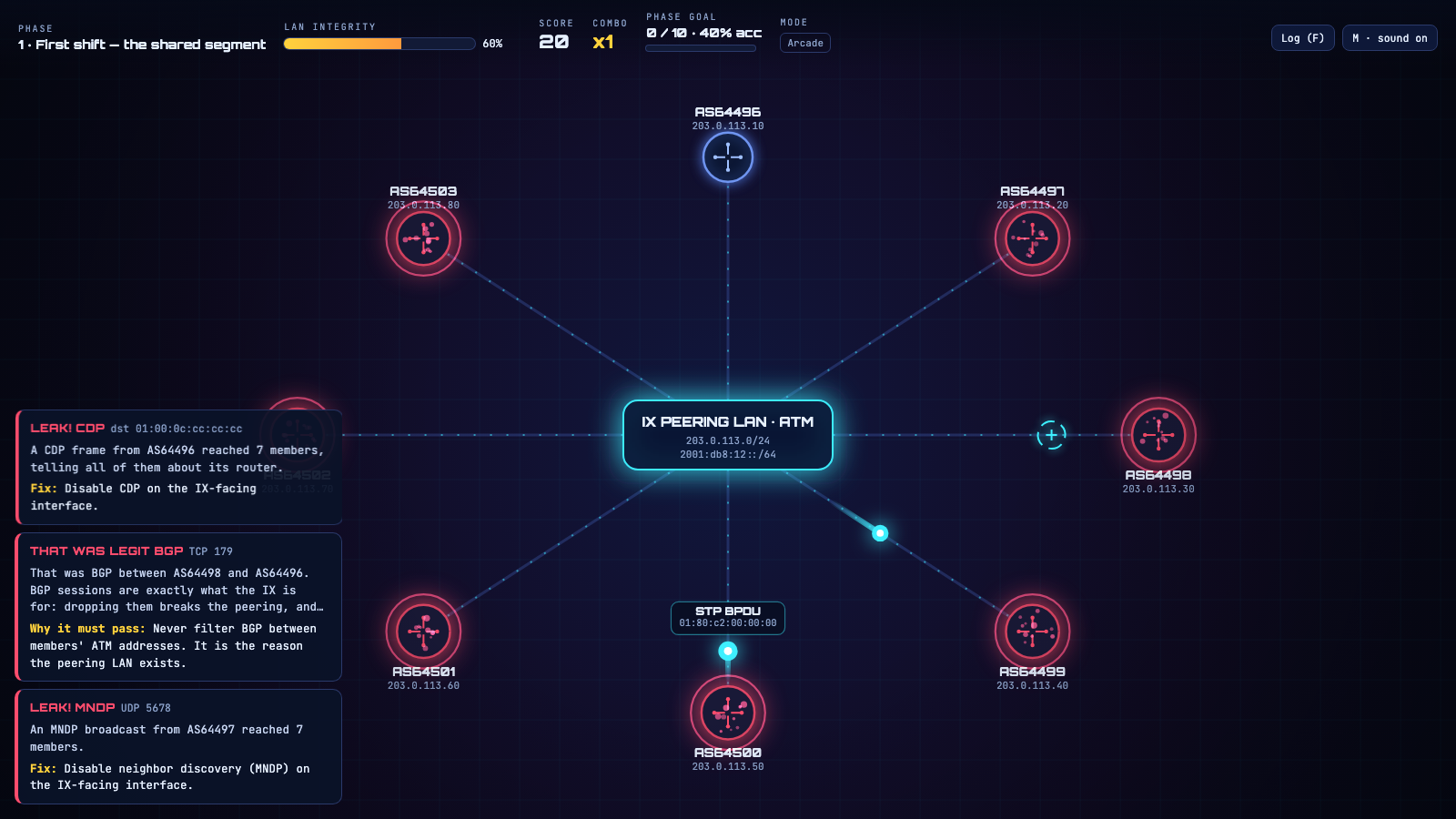
You are the NOC operator at an IX.br-style Internet Exchange. Packets fly from 8 member routers to the shared ATM peering LAN, and broadcasts split into copies that flood every member. Zap CDP, MNDP, STP, OSPF, PIM, IGMP, MLD, IPv6 RA/RS, ARP/NS for non-ATM addresses and broadcast NTP; let BGP, unicast traffic and ARP/ND for ATM addresses through. Every decision explains what the packet is and what to disable on your own IX-facing interface.
The builder
- Name
- Fabio Pessoa Nunes
- From
- São Paulo, Brazil
- Org
- Brasil Internet Exchange (IX.br) / NIC.br
- First spec project?
- Yes
- Began at
- NAF AC6
How it was built
- Model
- claude-opus-5-5
- Harness
- Claude Code
- Spec method
- GitHub Spec Kit 1.4.2.dev0 (from .specify/init-options.json)
- Spec artifacts
- constitution, spec, clarify, plan, tasks, analysis, checklists
- Tasks
- 73 in 8 loops
- Built
- November 18, 2026
- Human prompts
- 26
Build environment
- MCP servers
- claude.ai Claude Docs
- claude.ai Gmail
- claude.ai Google Calendar
- claude.ai Google Drive
- easel
- ide
- Sources & RAG
- Project owner's CONSTITUTION.md, SPEC.md and PLAN.md (packet catalog, phases, visual design system)
- NIC.br Boas Práticas IX (BCOP) course material, cited in the owner's spec; not fetched by the agent
- IX.br policy as confirmed by the project owner
- Model background knowledge of protocol headers and RFC 5737 / RFC 3849 / RFC 5398 documentation ranges (not fetched)
- Skills
- speckit-constitution
- speckit-specify
- speckit-clarify
- speckit-plan
- speckit-tasks
- speckit-analyze
- speckit-implement
- Other tools
- Node.js 25.2.1 built-in test runner
- Google Chrome 157 headless driven over the DevTools Protocol by a scratch test script
- Python 3 for scripted file edits
- sips
- AI assets
- code and tests: claude-opus-5-5
- explanation and briefing copy: claude-opus-5-5, from the owner's catalog (owner review pending)
- sound: synthesized in code with the Web Audio API, no audio files
- card image: screenshot of the running game, no image generator
Runtime: how to play
- Type
- static-web · HTML, CSS, JavaScript (classic scripts), Canvas 2D, Web Audio API
- Start
- open index.html in a desktop browser (no command or server needed)
- Install needed
- No
- Internet needed
- No
- API key needed
- No
- AI at runtime
- No
- Tested on
- Chrome 157 (headless)
- Saves
- browser localStorage (settings, unlocked phases, best scores)
- Accessibility
- Tested: full keyboard-only shifts (Tab, Space, L) from Phase 1 through endless in arcade and practice mode; a full shift with prefers-reduced-motion emulated; mute persisting across reload. Implemented but not tested with a real screen reader: an aria-live region announcing locks and every outcome.
Verification
- Tests
- 93 passing · node --test
- Facts from
- IX.br policy, confirmed by the project owner (11 of 20 packet entries are owner-confirmed; players see an 'official citation pending' note on them), NIC.br Boas Práticas IX (BCOP) course material (9 cited entries, as cited in the owner's spec), RFC 5737, RFC 3849, RFC 5398 documentation address and ASN ranges
- Known limits
- Packets follow scripted paths; no real switching fabric, MAC learning, route servers or BGP state machine
- Explanation and briefing text has not yet had the owner's content review (tasks T027, T052, T057a, T069 are open)
- In arcade mode the 80% accuracy gate rarely triggers, because legitimate packets that pass on their own count as correct decisions
- MLDv1 report (ICMPv6 type 131) is recognized by the rules engine but not spawned; MLD packets use types 130, 132 and 143
- Tested only in headless Chrome; Firefox, Safari and Edge untested
- Desktop target; touch zapping is implemented but no mobile layout was designed or tested
- English only
- License
- unknown
Who it is for.
Peering Patrol is an arcade game for network operators whose networks peer, or are about to peer, at an Internet Exchange. You keep the shared IX.br-style ATM peering LAN clean. You zap discovery protocols, IGPs, multicast chatter, IPv6 router discovery, and ARP or NS for non-ATM addresses before they flood all eight members. BGP, unicast traffic, and address resolution for ATM addresses must pass. Five phases build on each other up to "same protocol, different verdict" cases. The endless recall test then hides protocol names and shows only the header fields a capture would show.
THE BUILD STORYHow it was made.
We followed GitHub Spec Kit in order: constitution, specify, clarify, plan, tasks, analyze, implement. All of it started from the owner's root CONSTITUTION.md, SPEC.md and PLAN.md. The clarify step settled four rules: cards never pause play, how endless ends and what it saves, an 80% accuracy gate per phase, and that owner-confirmed facts ship with a visible "citation pending" note. The first analysis found that NTP multicast would not flood, that endless would be blocked by the empty-phase rule, and that content reviews came after merge. All three were fixed before any code was written.
During implementation the owner changed direction. Specs must not reference the prototype (constitution 1.1.0). A new look-and-feel section moved cards to the bottom left, with a shift log so no explanation is lost. A shift became one continuous run with checkpoints. The plan and tasks were regenerated, and a second analysis found seven more gaps.
Tests came first, and every verdict is also re-derived from structured header fields. Things that broke: `node --test tests/` fails on Node 25; headless Chrome's virtual time barely runs animation frames, so we drove real time over the DevTools Protocol; long cards covered the HUD; and an MLD label would have shown the wrong next header.
ADVICEFor the next builder.
- Store packets as structured header fields, not display strings, and have the engine re-derive every verdict in tests. It caught real mistakes, such as MLD's hop-by-hop next header.
- Decide early how "accuracy" counts packets the player never touched. Counting them as correct makes the gate easy in real-time mode.
- Drive the real game in a headless browser with a small script that uses the same input paths as players (click, Tab, Space). Unit tests alone would have missed the card stack covering the HUD.
Built a game of your own?
Fill in the ARCADE template with your build agent and send me your GitHub URL.
Add your game →