Permit or Pew
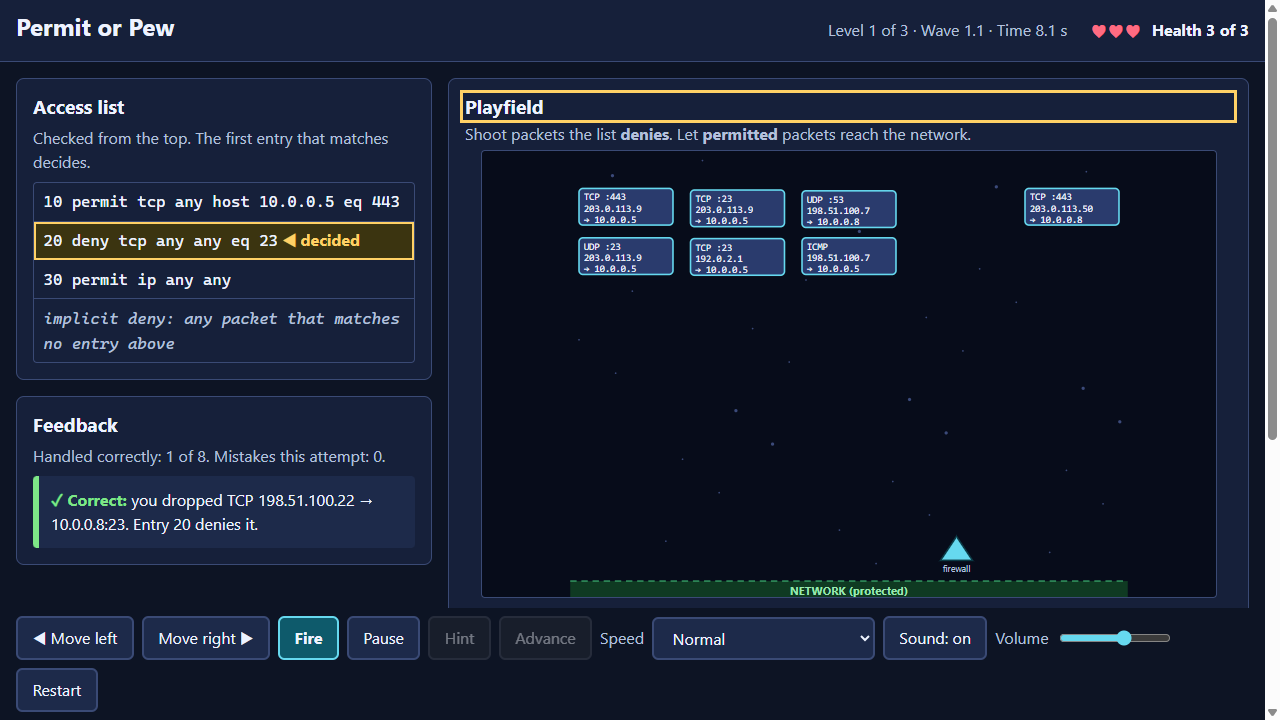
You are a firewall in a Galaga-style arcade game. Packets dive toward your network, and you read an access list to decide which to shoot and which to let through, losing health for every wrong call. After each wave, a review shows what you got wrong and which rule decided it.
The builder
- Name
- Jonathan Buchanan
- First spec project?
- Yes
- Began at
- NAF AC6
- Links
How it was built
- Model
- claude-sonnet-5-5
- Harness
- Claude Code 2.1.118
- Spec method
- GitHub Spec Kit 1.4.0
- Spec artifacts
- constitution, spec, clarify, plan, tasks, checklists
- Tasks
- 51 in 9 loops
- Built
- November 17, 2026
Build environment
- MCP servers
- claude-vscode (IDE integration; connected but not used)
- Sources & RAG
- Cisco IOS XE 17 ACLs Configuration Guide, Access Control Lists
- Cisco IOS XE Catalyst SD-WAN Qualified Command Reference Guide, ACL Commands
- RFC 4632 (CIDR)
- NAF AC6 workshop starter kit (CONSTITUTION, SPEC, PLAN and README templates)
- Skills
- speckit-constitution
- speckit-specify
- speckit-clarify
- speckit-plan
- speckit-tasks
- speckit-analyze
- speckit-implement
- Other tools
- Node.js 24 (a dependency-free test runner)
- headless Chrome 157 driven over the DevTools Protocol (end-to-end checks and screenshots)
- Python 3.14 (serve.py static server)
- WebFetch and WebSearch (reading the cited sources)
- AI assets
- images: none (the card image is a real screenshot of the game)
- audio: synthesized in the browser by code, no audio files
- 3D models: none
Runtime: how to play
- Type
- static-web · HTML, CSS, JavaScript ES modules, SVG, Web Audio API
- Start
- py serve.py
- Then open
- http://127.0.0.1:8000
- Install needed
- No
- Internet needed
- No
- API key needed
- No
- AI at runtime
- No
- Tested on
- Chrome 157.0.8103.51 (full automated checks, headless), Edge 157.0.4341.60 (the start screen loads with no errors; nothing else tested)
- Saves
- none (progress, mute and volume reset when the page reloads)
- Accessibility
- Tested by script in headless Chrome: all six waves played with real key presses only; every control has an accessible name; feedback is a live region; every fact is also text, including a text list of every packet; sound is an extra layer with a mute key and a volume slider; reduced motion and a 375 px window were emulated. NOT tested: a screen reader, a person using only the keyboard, touch, Firefox, Safari.
Verification
- Tests
- 208 passing · node tests/run-node.mjs
- Facts from
- Cisco IOS XE 17 ACLs Configuration Guide, Access Control Lists (How ACLs work; Create extended named ACLs), Cisco IOS XE Catalyst SD-WAN Qualified Command Reference Guide, ACL Commands (permit), RFC 4632 section 3.1 (CIDR prefix notation)
- Known limits
- Models one simplified ACL: IPv4 only, stateless, one destination port per entry, and CIDR ranges instead of Cisco wildcard masks.
- The Cisco pages do not say word for word that a tcp entry fails to match udp traffic; the game treats the protocol as an exact match.
- No person with networking knowledge has independently reviewed the 48 reference cases, the briefings or the explanations.
- The cited Cisco pages are for IOS XE and may change.
- Difficulty and pace were tuned from one person's playtesting.
- No touch controls, no score, and mute and volume are not saved across reloads.
- License
- Apache-2.0
Who it is for.
Permit or Pew is a Galaga-style browser game that teaches beginners to read an access control list. You are a firewall: a formation of packets, each showing its protocol, addresses and port, dives toward your network, and the ACL on screen tells you which to shoot and which to let through. Every mistake costs health and is explained in a short review after the wave, with the rule that decided it. It is for software developers and IT beginners who have never read an ACL, and it runs from static files with no account, install or network.
THE BUILD STORYHow it was made.
We followed the Spec Kit order: the starter constitution was personalised, then specify, clarify, plan, tasks, an analysis pass that found 13 issues (all fixed), and implement, with tests written before the code. The first build used four lanes and paused the game on every mistake, and playtesting called it gamified flash cards. We replaced it with a free-moving Galaga-style game and amended the constitution openly, which was the biggest change of direction. Later rounds, each driven by playing it, changed the default pace, added a health system that heals on right decisions, fixed a Pause button that kept keyboard focus, shortened the start page, redesigned the results so a pass and a fail look different, put the rules on the results page, and added synthesized sound. One failure came from stale files cached by the browser, which left the page on Loading; we reproduced it, added a no-cache server and a message that says what to do. We checked the game in headless Chrome with real key presses and mouse clicks, looked at the screenshots, and deliberately broke code on a scratch copy to confirm the tests could fail. The sources were opened and read before being cited. A person has not yet reviewed the networking content.
ADVICEFor the next builder.
- Look at screenshots and drive the real game, not just test counts; the biggest problems (a game that felt like flash cards, a hidden button, a layout that did not fit the screen) only showed up that way.
- Check what a rule actually costs the player before you write it into the constitution; ours had to change several times once the game was playable.
- Serve with the no-cache server in this repo, because a plain static server let a browser mix old and new files and the game silently failed to start.
Built a game of your own?
Fill in the ARCADE template with your build agent and send me your GitHub URL.
Add your game →