Round Trip
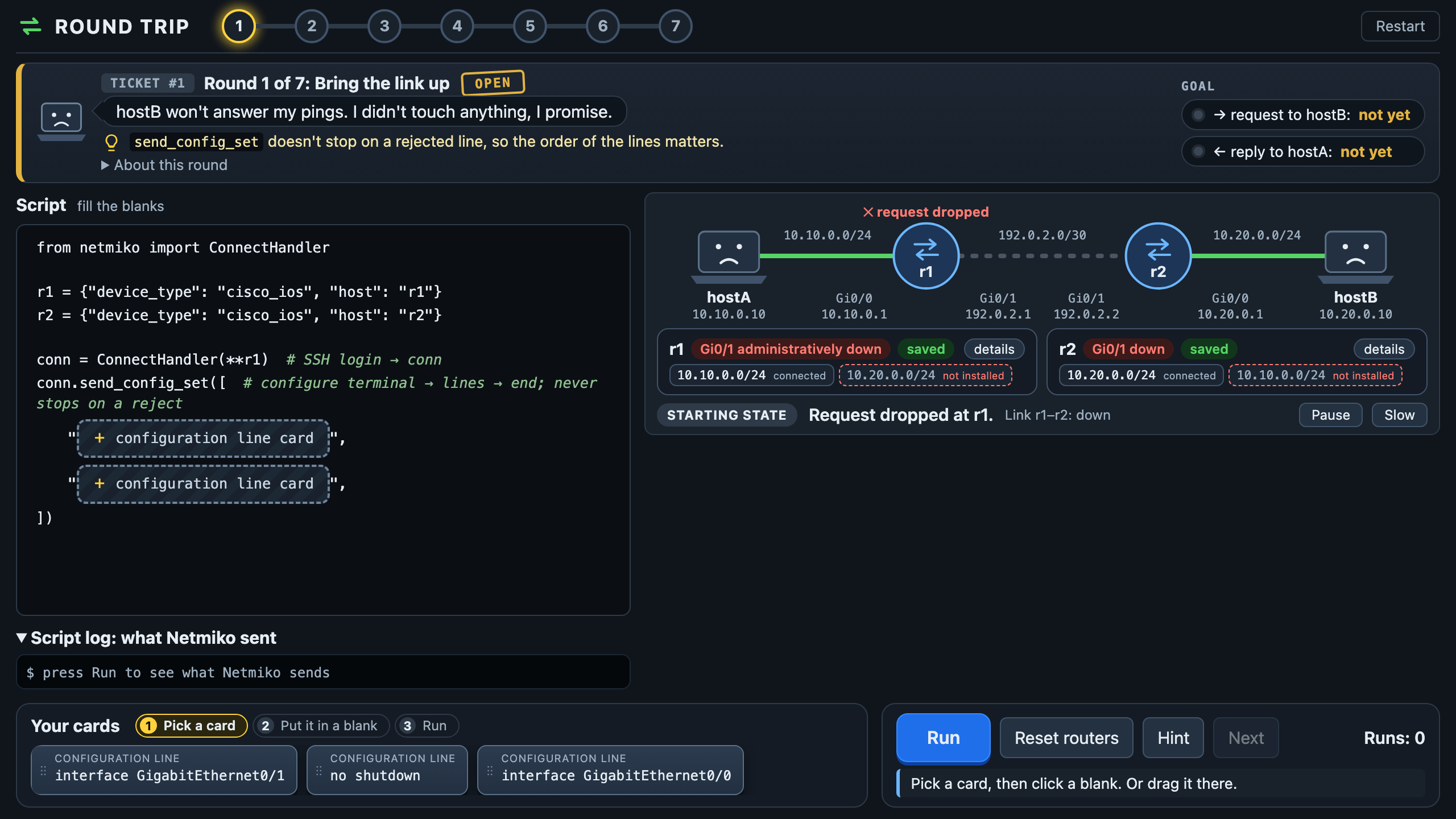
The player places code cards into the blanks of a short Netmiko-style script, runs it against two simulated routers, and watches a ping travel from hostA to hostB and back. They learn that a script that ran without crashing has not necessarily fixed the network, by keeping apart what the script sent, what the router holds in its configuration, and what traffic does.
The builder
- Name
- Shannon Byrnes
- From
- Arizona, USA
- First spec project?
- Yes
- Began at
- NAF AC6
How it was built
- Model
- claude-fable-5-2+ claude-haiku-5-5 (called by the harness itself; purpose not recorded)
- Harness
- Claude Code 2.1.326
- Spec method
- GitHub Spec Kit 1.4.2.dev0
- Spec artifacts
- constitution, spec, clarify, plan, tasks, checklists, research, data-model, contracts, quickstart
- Tasks
- 61 in 10 loops
- Built
- November 17, 2026
- Human prompts
- 54
Build environment
- MCP servers
- None recorded
- Sources & RAG
- The author's own SPEC.md design document for the game
- NAF AC6 workshop lab instructions and StarterKit (github.com/automateyournetwork/NAF_AC6)
- Netmiko source, fetched: base_connection.py, cisco_base_connection.py, cisco/cisco_ios.py
- IETF RFC 1812, fetched from rfc-editor.org
- Cisco, Configure Route Selection for Routers (Document ID 8651), fetched
- Python Language Reference 8.3 (the for statement) and Library Reference (NameError), fetched
- Other references listed in the README (Netmiko API docs, three Cisco IOS/IOS XE guides, a Cisco Learning Network thread) are cited in the spec; whether the agent fetched them is unknown
- Skills
- Spec Kit skills as slash commands: speckit-constitution, speckit-specify, speckit-clarify, speckit-plan, speckit-tasks, speckit-analyze, speckit-implement
- Claude Code /loop (three loop runs, eight scheduled iterations)
- Other tools
- node --test (Node v26.11.1)
- headless Google Chrome 157 driven by script
- python3 http.server via serve.py
- specify CLI
- git
- gh
- curl
- WebFetch
- WebSearch
- AI assets
- images: none (the two files in assets/ are screenshots of the running game; the diagram, faces and icons are HTML, CSS and inline SVG written by the build agent)
- audio: none
Runtime: how to play
- Type
- static-web · HTML, CSS, ES modules, JSON content file, no framework, no build step
- Start
- python3 serve.py
- Then open
- http://127.0.0.1:8000
- Install needed
- No
- Internet needed
- No
- API key needed
- No
- AI at runtime
- No
- Tested on
- Chrome 157 (headless, driven by script; no person has played it through)
- Saves
- none (progress lasts for the page session only)
- Accessibility
- Tested by script in headless Chrome only: all seven rounds completed with keyboard focus and key events, and reduced motion emulated. Screen-reader output was not listened to, touch was not checked, and the author has not yet run their own check.
Verification
- Tests
- 110 passing · node --test tests/
- Facts from
- Netmiko source: base_connection.py, cisco_base_connection.py, cisco/cisco_ios.py, Netmiko API documentation, netmiko.base_connection, Cisco IP Routing Configuration Guide, IOS XE 17.17 (Catalyst 9600), Protocol-Independent Features, Cisco IOS IP Routing Protocol-Independent Command Reference, ip route, Cisco Using the Command-Line Interface, Catalyst 9300, IOS XE 17.17, Cisco Configure Route Selection for Routers (Document ID 8651), IETF RFC 1812, section 5.2.4.3, Python Language Reference 8.3 and Library Reference (NameError), Cisco Learning Network thread 46334 (a forum post, not Cisco documentation)
- Known limits
- A simplified simulator of Cisco IOS behaviour; no real device, remote session or Python interpreter is involved
- Not modelled: ARP, dynamic routing, administrative distance, equal-cost paths, recursive next hops, exit-interface static routes, IPv6, privilege modes, authentication failures, timeouts, ICMP errors
- Rules 1 and 2 (CLI context and link state) have no reference; rule 4 rests on a forum post
- Two router messages were not captured from a real device, so the game paraphrases them
- The take-away script was checked against Netmiko's source but never run against Netmiko or a real router
- Only one script error is modelled: using conn before connecting
- The rule-by-rule check against references and the author's own playthrough have not been done
- Below 768 px wide and touch input are unchecked
- License
- Apache-2.0
- Tokens
- 90,403,347 in · 582,368 outToken counts are summed from the harness session transcripts for claude-fable-5-2; helper-model tokens and the billing arrangement are unknown
Who it is for.
Round Trip is a browser game for network engineers who are new to automation. Each of its seven rounds is a short Netmiko-style script with blanks: you place code cards, press Run, and watch a ping try to go from hostA to hostB and back across two simulated routers. After every Run the game shows what Netmiko sent, what each router did with it, where the traffic stopped and the rule behind it. It targets one misconception, that a script which ran without crashing has fixed the network. The last round has you assemble a whole script, which you can copy away as real Netmiko code.
THE BUILD STORYHow it was made.
The build ran in Claude Code with GitHub Spec Kit, over sittings on two days. The author brought their own SPEC.md. From it we wrote the constitution, then the spec, then two rounds of clarification, the plan, the tasks, and an analysis pass, and committed those before any code. A fresh session reran analysis, clarified again, replanned, and then implemented the first playable build of four rounds.
The author changed direction several times. Early on they asked why a Run should force the player to wait; that became a constitution rule that the player never waits, a ping that repeats on the diagram, and a Reset routers button. After playing the first build they asked for Pause and Slow and collapsible panels. Three `/loop` runs followed: one on visuals and layout, one that grew the game from four rounds to seven with a take-away script, and one that cut the on-screen text. Each change went back into the spec and tasks.
One thing broke. During the seven-round loop the author reported the game no longer worked. The code and tests were fine; the cause, inferred and then reproduced, was the browser mixing cached old modules with new ones under `python3 -m http.server`. The fix was `serve.py`, which sends `Cache-Control: no-store`, and a start-up error message in place of an endless "Loading".
ADVICEFor the next builder.
- Serve ES modules with caching turned off while the agent is changing them. A stale module fails silently and looks like a broken game.
- Keep the expected results in a file worked by hand that never calls the simulator. Ours checks every placement of every round, so content changes cannot quietly change an answer.
- Record who verified what. Our browser checks were run by the agent in headless Chrome; the README says so and leaves the author's own column empty until a person plays it.
Built a game of your own?
Fill in the ARCADE template with your build agent and send me your GitHub URL.
Add your game →