Split Decision
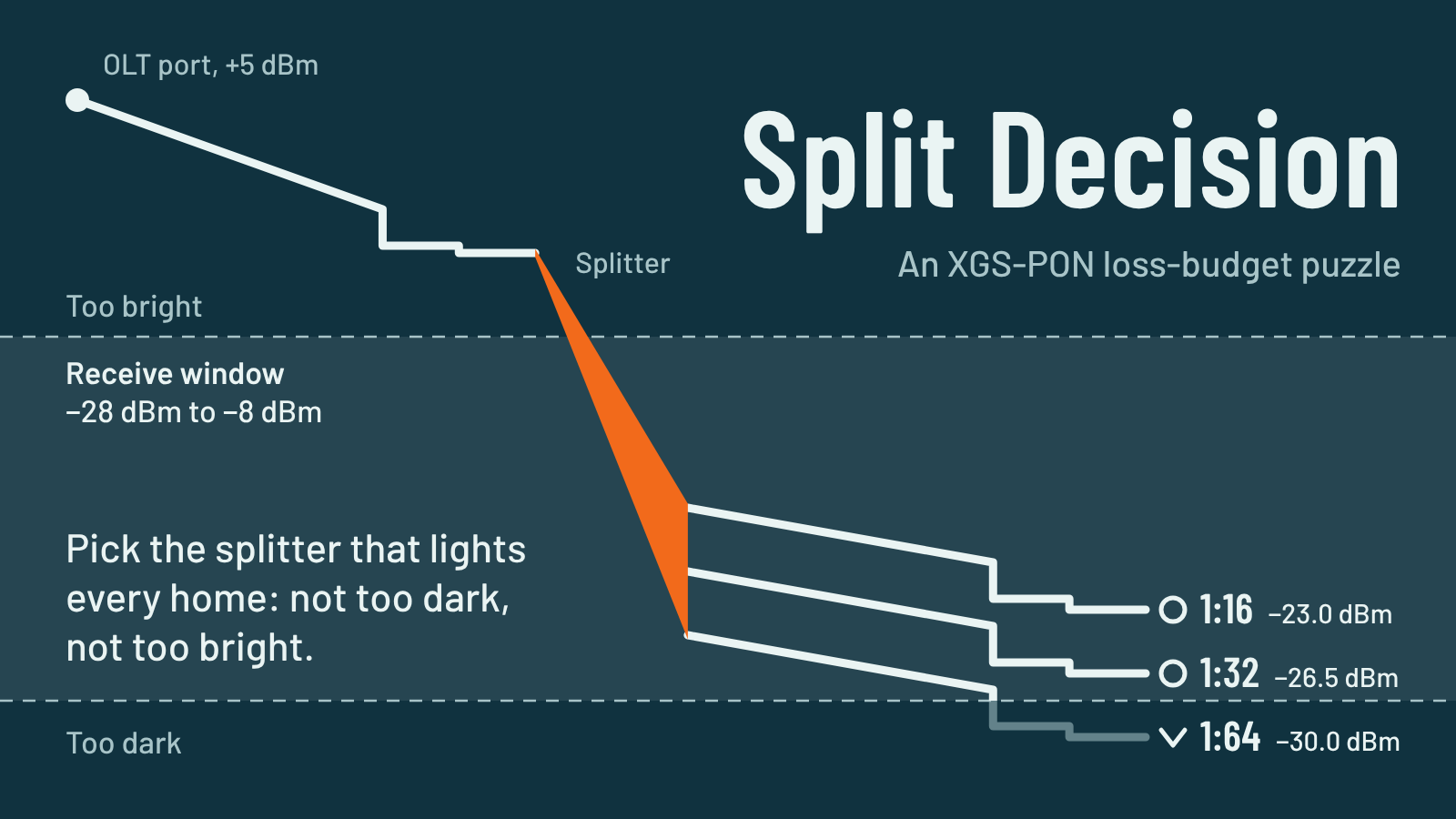
You design the outside plant of a small fiber network. Each work order shows a PON, and you choose the splitter or the attenuator that gives every ONT a receive level inside its window while serving the most homes. A loss trace and a dB-by-dB ledger explain every result, right or wrong.
The builder
- Name
- John Kicklighter
- First spec project?
- No
- Began at
- NAF AC6
How it was built
- Model
- claude-fable-5-2
- Harness
- Claude Code 2.1.328
- Spec method
- GitHub Spec Kit specify CLI 1.4.3.dev0
- Spec artifacts
- constitution, spec, clarify, plan, tasks, analysis, checklists
- Tasks
- 83 in 9 loops
- Built
- November 19, 2026 · 8h26m39s
- Human prompts
- 14
Build environment
- MCP servers
- Called: claude-artifacts (one private review build published for the owner), claude-code-remote (listing repositories), the harness's past-chat search and memory (read once each at the start)
- Connected but not called: Claude Docs, Claude in Chrome, Google Drive, remote-devices, visualize, widgets
- Sources & RAG
- ITU-T G.9807.1 (02/2023), Annex B
- ITU-T G.652 (08/2024), Table 2 and Appendix I
- The FOA Reference Guide: loss estimates; attenuators
- TEC GR/TX/OPT-001/01/APR-12 (splitter insertion loss)
- NAF AC6 workshop repository: lab guide, StarterKit, three example games, the workshop deck
- The Arcade page at automateyournetwork.com/arcade
- The card images of 13 other Arcade games, read from their public repositories to compare with this game's card; nothing was copied
- The owner's field experience: the receive window, the launch power, and the wording about connectors
- Skills
- Spec Kit skills: speckit-constitution, speckit-specify, speckit-clarify, speckit-plan, speckit-tasks, speckit-analyze, speckit-implement
- frontend-design skill
- dataviz skill and its palette validator
- pptx skill (to read the workshop deck)
- Other tools
- git
- Node 22.23.5 (unit tests)
- Python 3.13.18 (answer-key oracle, browser checks)
- Playwright 1.63.0 with Chrome for Testing 153.0.8010.12, headless
- Pillow 12.3.0 (card image)
- fontTools 4.67.0 (inspecting the vendored fonts)
- axe-core 4.14.1 (accessibility audit, run in the browser checks)
- npm (to fetch the Fontsource packages of Barlow, and axe-core)
- AI assets
- code, content and documents: written by the build agent
- drawings and icon: SVG written by the build agent
- card image: an SVG page written by the build agent (tools/card.html) that draws the card with the game's engine, colors and typefaces, captured in headless Chrome; no image generator
- README screenshot: a capture of the running game
- fonts: not AI (Barlow, SIL Open Font License)
- audio: none
Runtime: how to play
- Type
- static-web · HTML, CSS, JavaScript ES modules, inline SVG
- Start
- python3 -m http.server 8000 --bind 127.0.0.1
- Then open
- http://127.0.0.1:8000
- Install needed
- No
- Internet needed
- No
- API key needed
- No
- AI at runtime
- No
- Tested on
- Chrome for Testing 153 (headless, Playwright), The same browser emulating a phone with a touch screen; no real phone
- Saves
- none; reloading the page starts a fresh session
- Accessibility
- Tested by automation in headless Chrome only: a keyboard-only playthrough of all six work orders with visible focus; accessible names for every control; text contrast of at least 4.5 to 1; no violation reported by axe-core 4.14.1 in 12 views; no animation under reduced motion; no sideways scrolling at 320 pixels; a playthrough with taps only in an emulated phone, upright and on its side, with no button or option under 40 CSS pixels. Each state has words and a shape. Not tested by a person, with a screen reader, on a real phone, or in Firefox or Safari.
Verification
- Tests
- 200 passing · node tests/run-node.mjs && python3 tools/oracle.py && python3 tools/e2e.py
- Facts from
- The project owner's field practice (the game's receive window, -28 to -8 dBm, and its launch power, +5 dBm; decisions D13 and D14 in the specification), ITU-T G.9807.1 (02/2023) Annex B, clause B.9.2.6.2, Table B.9.3 (the standard's OLT launch power and ONU receiver figures, shown for comparison), ITU-T G.9807.1 (02/2023) Annex B, clause B.6.1, Table B.6.1 (the standard's N1 and N2 loss classes, shown for comparison; attenuators below the class minimum), ITU-T G.9807.1 (02/2023) Annex B, clauses B.9.2.6.1 and B.9.2.8.1 (what the loss range includes; wavelengths), ITU-T G.652 (08/2024) Appendix I, Table I.1 (fiber attenuation), The FOA Reference Guide (connector and splice loss; attenuators), TEC GR/TX/OPT-001/01/APR-12 (splitter insertion loss)
- Known limits
- The owner has played the review copy and reported no fault; nobody has timed a playthrough, and every recorded check was run by a script in headless Chrome
- Only the level an ONT receives is checked, with the upstream fiber value; the upstream direction is not checked, and no repair or ageing margin is kept
- One launch power stands for the range of a real transmitter, with no path penalty
- Splitters lose 3.5 dB for each two-way split, with no difference between ports
- The receive window and the launch power are the owner's field values, not figures quoted from ITU-T G.9807.1
- The standard's limit on the difference between two paths is not graded
- Reflectance and bend loss are not modeled
- Six fixed work orders
- The loss card's planning values were chosen by the build agent inside published ranges; asked about the fiber value, the owner kept the card as it is
- License
- Apache-2.0
Who it is for.
Split Decision is a puzzle about the first question of PON design: how far can this route be split? You are handed six work orders in the fictional Saguaro Valley. Each shows a small XGS-PON, a loss card, the launch power at the OLT and the window of light an ONT can work with, and you choose the splitter, or the attenuator, that puts every ONT's receive level inside that window while serving the most homes. A loss trace shows the light level falling at each element of the path, and a ledger adds it up, so a wrong design teaches as much as a right one. It is for network engineers, sales engineers and students who know IP networking and have never budgeted an optical path; nothing about optics is assumed.
THE BUILD STORYHow it was made.
The owner chose the topic and asked the build agent to make the design calls from the workshop's defaults, record each one, and hand back a playable game to review. The agent read the workshop materials and the ITU-T and FOA sources, designed six work orders, and worked every option by hand before any code existed. That hand-worked key became the specification's test cases.
Spec Kit ran in order: constitution, specify, clarify, plan, tasks, analyze. Planning found that the specification let feedback name the answer for a design that works but is too small, and the specification was corrected. Analysis found 16 issues, one critical; all but two minor ones were fixed in the artifacts before any code.
Implementation began with the tests. The engine passed on its first run, which proves little, so bugs were planted to see the tests fail; in the final build that was 26 bugs, all caught. A keyboard-only browser check found a real fault, a late close event that could cancel a restart dialog just reopened.
Then the owner reviewed it, twice. First he set the window's limits at 8 and 28 and had "connector pair" changed to "connector", because a PON is a single fiber. The agent applied 8 and 28 as path loss, as written, and recorded the other reading. In the second review he said they are the ONT's receive levels and gave the launch power, so the game now works out a receive level in dBm for every ONT. Two points were left with him, the sign of that launch power and the loss card's fiber value, and he settled both: plus five, and keep the card. He also asked how the card image compared with the others in the Arcade. It was the plainest of them, a screenshot too small to read, so the game's own engine now draws its card. Each time the change went into the specification and the constitution first; the work orders were re-worked by hand, the tests were seen to fail, and then the content and the code changed.
ADVICEFor the next builder.
- Work your answers by hand before the code exists, and keep them in a file the code never writes. Ours is checked three ways: by the unit tests, by a second implementation in another language, and by a browser that reads the numbers off the page. When the owner changed the window, and then its unit, that file changed first and the tests failed, which is what told us exactly what to re-work.
- When everything passes on the first run, plant a bug. A suite that has never failed has not shown that it can.
- Do not type numbers into sentences. Our briefings and explanations carry tokens that the engine fills, so changing the loss card cannot leave a stale sentence behind, and the validator names any work order whose answer moved.
Built a game of your own?
Fill in the ARCADE template with your build agent and send me your GitHub URL.
Add your game →