TCP Kart: Congestion Control
Players predict how a TCP sender changes its congestion window, then watch a race illustrate the event and compare the prediction with the result. Three levels introduce slow start, congestion avoidance, and timeout response.
The builder
- Name
- josemi
- From
- Madrid, Spain
- First spec project?
- No
- Began at
- NAF AC6
How it was built
- Model
- unknown+ unknown
- Harness
- Copilot in VS Code
- Spec method
- GitHub Spec Kit 1.0.6.dev0
- Spec artifacts
- constitution, spec, clarify, plan, tasks, checklists
- Tasks
- 30 in 6 loops
Build environment
- MCP servers
- unknown
- Sources & RAG
- RFC 5681
- RFC 9438
- GitHub Spec Kit workshop materials
- Skills
- brainstorming
- writing-plans
- test-driven-development
- systematic-debugging
- verification-before-completion
- Other tools
- Node.js test runner
- Python HTTP server
- VS Code integrated Chromium
- Playwright browser tools
- Git
- AI assets
- Procedural 3D circuit and kart geometry authored with coding assistance
Runtime: how to play
- Type
- static-web · HTML, CSS, JavaScript ES modules, Three.js r180
- Start
- python3 -m http.server 8000 --bind 127.0.0.1
- Then open
- http://127.0.0.1:8000
- Install needed
- No
- Internet needed
- No
- API key needed
- No
- AI at runtime
- No
- Tested on
- VS Code integrated Chromium 150.0.7871.250
- Saves
- In memory only; reloading starts a new session.
- Accessibility
- Keyboard playthrough completed; visible focus, reduced motion and a non-WebGL schematic are supported. Screen-reader testing has not been performed.
Verification
- Tests
- 34 passing · npm test
- Facts from
- RFC 5681, RFC 9438
- Known limits
- Human review of networking claims against the RFCs is still pending
- Deterministic Reno-style teaching subset, not a complete TCP simulation
- Fast retransmit, fast recovery, ECN, receiver-window effects, CUBIC and BBR are not modeled
- Race animation illustrates the exchange rather than simulating packet timing
- License
- Apache-2.0
Who it is for.
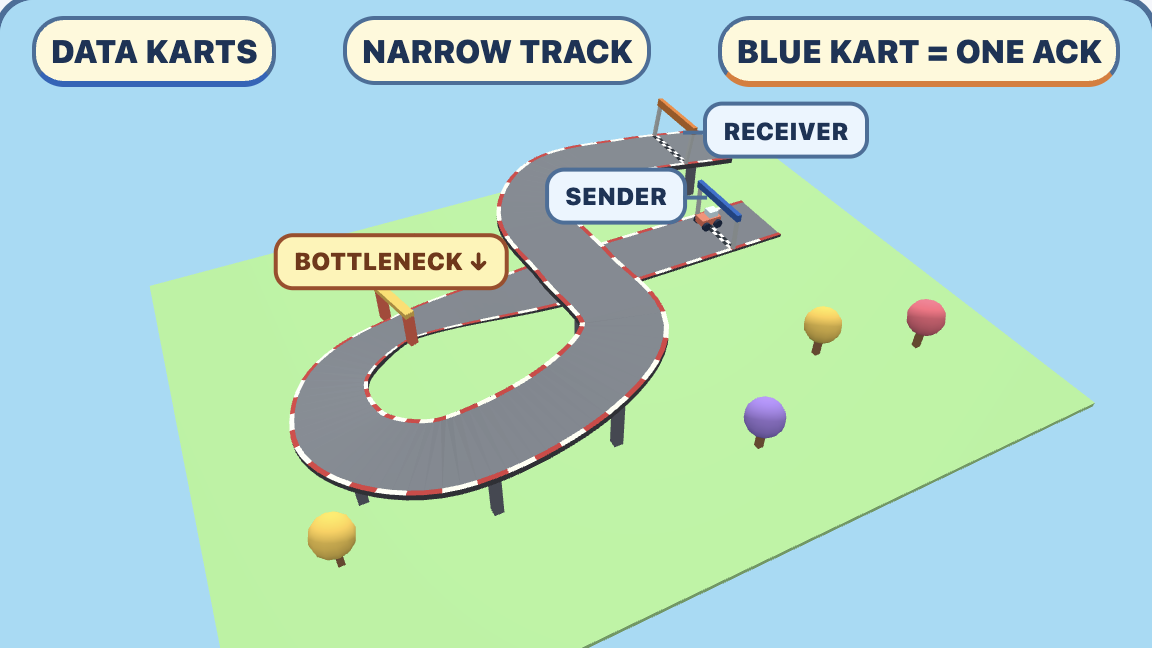
TCP Kart is a beginner-friendly game about congestion control. Players learn what data, ACKs, the congestion window and a bottleneck represent, then predict the sender's next state in six rounds. A circuit illustrates the exchange and the game explains each answer. It is intended for people learning TCP fundamentals.
THE BUILD STORYHow it was made.
We used the workshop's Spec Kit workflow: constitution, specification and clarifications, plan, tasks, analysis, then implementation. The game separates the deterministic rule evaluator from the visuals, so an illustration does not decide whether an answer is correct. The authored cases and explanations refer to RFC 5681; the model deliberately covers only a subset of TCP congestion control, and human review of its networking claims remains outstanding.
Player feedback changed the direction of the visuals. The first version felt repetitive, so we introduced a narrowing circuit and showed the player's prediction alongside the computed result. The player also noticed ACKs appearing too early; the animation was changed so each ACK leaves only after the data it covers reaches the receiver. An apparently unresponsive start button worked after a hard refresh, suggesting a stale browser tab. Finally, we added a plain-language introduction and a worked example because the game needed to teach the basics before asking questions. Automated tests and a browser playthrough check the rules and the session flow.
ADVICEFor the next builder.
- Keep the networking rules independent of the animation and test their boundaries.
- Explain the data and ACK sequence before asking a beginner to make a prediction.
- Check a fresh browser session after changing modules or content; cached files can obscure changes.
Built a game of your own?
Fill in the ARCADE template with your build agent and send me your GitHub URL.
Add your game →