Throughput
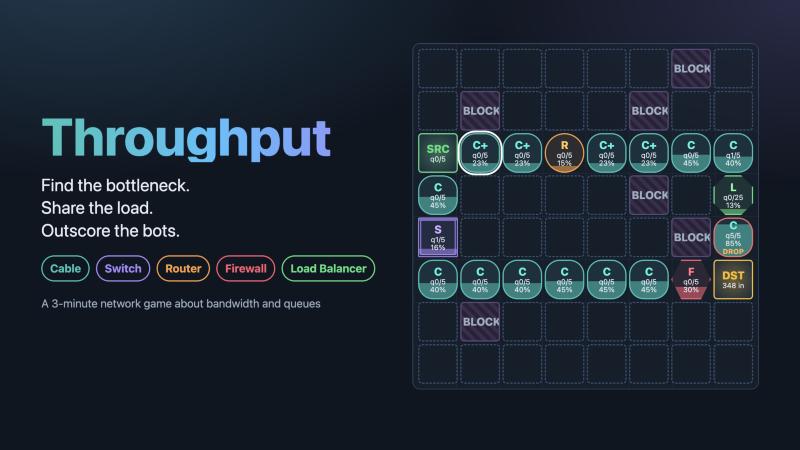
Throughput is a short browser game where you build a chain of network devices that carries packets from a Source to a Destination while three bots compete and attack. Seven random events and six attacks are announced with a five-second countdown, two of the attacks need a combination of equipment to stop, and a live leaderboard tracks the race. After each decision it names the bottleneck, teaching that a path is only as fast as its slowest device and that parallel paths share load.
The builder
- Name
- Sharanya
- From
- Arizona
- Org
- Lumen
- First spec project?
- Yes
- Began at
- NAF AC6
How it was built
- Model
- claude-sonnet-5-5+ unknown (one fetch subagent read the Arcade page; its model was not recorded)
- Harness
- Claude Code in the Claude desktop app (Code tab)
- Spec method
- GitHub Spec Kit 1.4.2.dev0
- Spec artifacts
- .specify/memory/constitution.md, specs/001-solo-vs-bots/spec.md, specs/001-solo-vs-bots/plan.md, specs/001-solo-vs-bots/tasks.md, specs/001-solo-vs-bots/analysis.md, StarterKit/CONSTITUTION.md, StarterKit/SPEC.md, StarterKit/PLAN.md
- Tasks
- 25
- Workflow
- Seven workshop steps run by hand, one at a time. No Ralph loop.
- Built
- November 17, 2026
Build environment
- MCP servers
- Claude Docs connector (wrote the rules document)
- Claude built-in browser (playtesting and the card image)
- Terminal panel (git push, run by the human)
- Sources & RAG
- GitHub Spec Kit bundled templates and skill files, version 1.4.2.dev0
- The workshop lab guide, pasted by the human
- https://automateyournetwork.com/arcade/ (submission page and ARCADE.md template)
- Skills
- Spec Kit skill files in .claude/skills (read and followed by hand, not invoked as commands)
- Other tools
- uv
- specify-cli
- node 22 (node --test)
- python3 (http.server)
- git
- gh (GitHub CLI)
- GitHub Pages
- AI assets
- All code, tests, documentation, spec artifacts and interface text were written by the AI agent. No images or audio were generated. The card image (assets/card.jpg) and README screenshot (assets/screenshot.jpg) are screenshots of the running game, and the card adds a title and tagline overlay made in the browser.
Runtime: how to play
- Type
- static-web · HTML, CSS and JavaScript ES modules. No build step. Node is only used for tests.
- Start
- python3 -m http.server 8000 --bind 127.0.0.1
- Then open
- http://localhost:8000
- Install needed
- No
- Internet needed
- No
- API key needed
- No
- AI at runtime
- No
- Tested on
- Played in the Claude built-in browser pane (Chromium based) only. Other browsers were not tried.
- Saves
- none. Reloading returns to the setup screen.
- Accessibility
- Board tiles are buttons with descriptive labels, arrow-key movement, letter shortcuts, visible focus, and text labels in addition to colour. Countdown warnings sit in a polite live region. A screen reader was not tested.
Verification
- Tests
- 60 of 60 on 2026-11-17 · node --test (60 unit tests), node scripts/head-to-head.mjs and node scripts/bots-vs-bots.mjs (bot balance), a manual browser playthrough recorded in docs/PLAYTEST.md, and a check that the hosted GitHub Pages site loads and runs a round
- Facts from
- The game's own traffic model, defined in specs/001-solo-vs-bots/spec.md. It was not checked against an external networking source or by an independent reviewer.
- Known limits
- Solo vs Bots only. Versus and Co-op are designed in docs/ but not built.
- No second person has playtested without coaching.
- Offline play was not tested, though the code makes no network calls.
- The hosted Pages site was checked once, in one browser, by loading it and running a round with scripted commands. It was not clicked through by hand.
- Desktop only. Phone layout and screen readers were not tested.
- Sponsor grant and Routing glitch were covered by unit tests but not seen firing in the browser.
- Bots do not react to the five-second attack warnings; only the human player can use them.
- In three-way bot rounds the Normal bot often beats Hard because the leader draws everyone's attacks. One-on-one duels order the bots as expected.
- No licence file yet.
- License
- unknown
Who it is for.
Throughput puts you in charge of a tiny network. You place cables, switches, routers, firewalls and load balancers on an 8 by 8 grid so packets can flow from a Source to a Destination, and every delivered packet scores a point. Three bots play the same map and attack you, random events and attacks are announced with a five-second countdown so you can react, and a leaderboard under your board ranks everyone until the last 10 percent of the round hides it. The game shows how full each queue is, names the bottleneck when packets drop, and tells you if you upgraded the wrong link. A round takes 3 minutes in Practice or 10 minutes in the full version.
THE BUILD STORYHow it was made.
The game followed the seven workshop steps with GitHub Spec Kit: constitution, specification, clarification, plan, tasks, analysis and implementation. The Spec Kit slash commands were not available as commands during the session, so the agent followed each command's instruction file by hand and wrote the same artifacts. The simulation was written first as plain JavaScript with no browser code, and three hand-worked cases were turned into tests before the interface existed: a correct case, a wrong upgrade and parallel paths. Building the game exposed design faults that the written spec had missed. A Source and Destination on the same row allowed only one shortest path, which made load balancing impossible, so both were moved. A flood attack did nothing until the order of queue updates was changed. Bots rebuilt cables where they had just removed one to fit a firewall. The interface was played through in the built-in browser using the keyboard only. Later requests added a colour pass, two more random events, two attacks that need two kinds of equipment to stop, a live leaderboard and a five-second warning before every event and attack, each with new tests. The warning meant attacks no longer land instantly. The static site was published on GitHub Pages and checked there. The online modes in the original design were left out to keep the first version small and static.
ADVICEFor the next builder.
- Work out your fixtures by hand first and check the geometry of your map, because one rule about which neighbour a packet takes decided whether a whole game mechanic could work.
- Test the bots against each other early. Three of the bugs found were in bot behaviour, not in the rules.
- Keep every number in one file so tuning balance never means touching logic.
Built a game of your own?
Fill in the ARCADE template with your build agent and send me your GitHub URL.
Add your game →