Uptime Survivors
You are the network engineer: steer while your tools (Ping, Firewall Rules, Ansible Playbooks, Load Balancers, Traceroute, Rate Limiters, Null Routes) fire on their own at network problems such as packet loss, BGP route flaps, broadcast storms and DDoS botnets, plus three Major Incidents. Every enemy, tool and upgrade is tied to a real networking concept, and an in-game Field Guide explains each one.
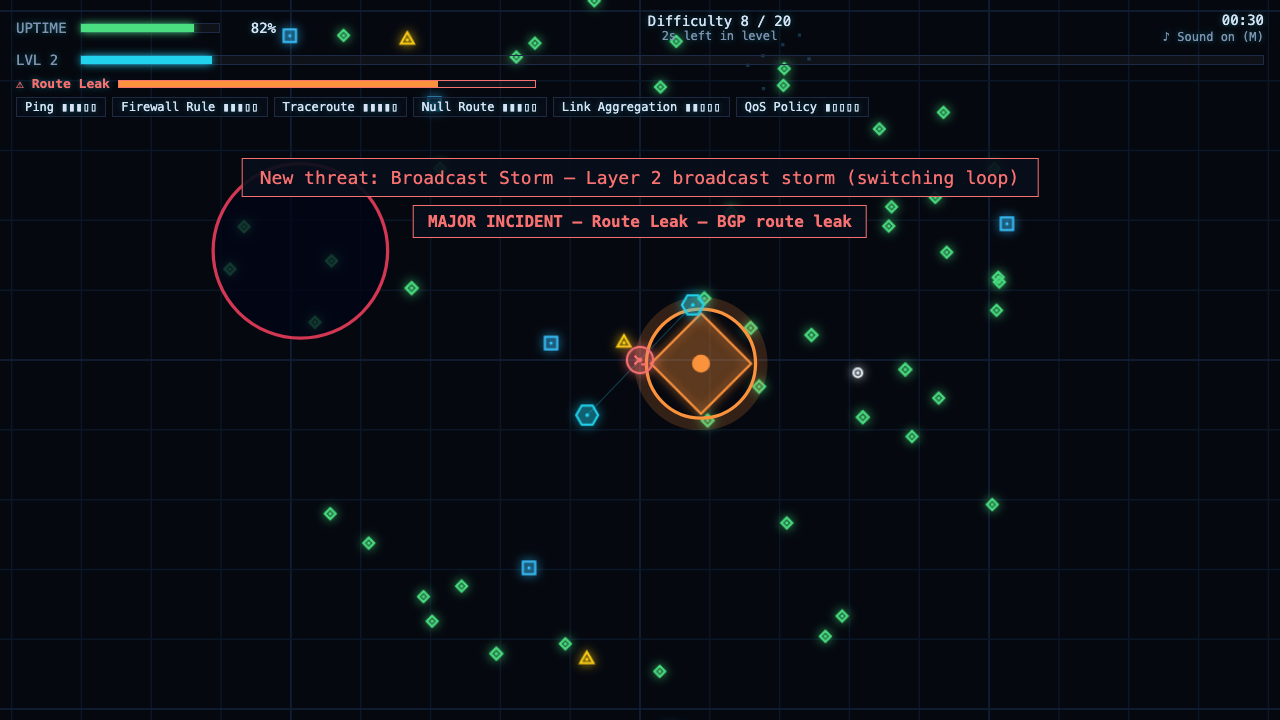
The builder
- Name
- TJ Mohr
- From
- United States
- First spec project?
- Yes
- Began at
- NAF AC6
- Links
How it was built
- Model
- claude-opus-5-5
- Harness
- Claude Code 2.1.327 (updated to 2.1.328 after the build)
- Spec method
- GitHub Spec Kit 1.4.2.dev0 (speckit_version in .specify/init-options.json; `specify version` not run)
- Spec artifacts
- constitution, spec, clarify, plan, research, data-model, contracts, quickstart, tasks, checklists
- Tasks
- 292 in 6 loops
- Built
- November 18, 2026
Build environment
- MCP servers
- None recorded
- Sources & RAG
- .specify/memory/constitution.md (project constitution)
- Spec Kit templates in .specify/
- Skills
- speckit-constitution
- speckit-specify
- speckit-clarify
- speckit-plan
- speckit-tasks
- speckit-analyze
- ralph-loop plugin (/ralph-loop:ralph-loop and its stop hook)
- Other tools
- JavaScriptCore jsc (macOS) test runner
- Python 3 (http.server, browser test driver)
- headless Google Chrome 157 via the DevTools Protocol
- git
- GitHub
- GitHub Pages
- AI assets
- visuals: code-drawn Canvas 2D shapes and inline SVG icons written by the agent
- audio: synthesized in the browser (Web Audio) from data written by the agent
- images: none
- audio files: none
Runtime: how to play
- Type
- static-web · HTML, CSS, JavaScript ES modules, Canvas 2D, Web Audio API
- Start
- python3 -m http.server 8000 --bind 127.0.0.1
- Then open
- http://127.0.0.1:8000/
- Install needed
- No
- Internet needed
- No
- API key needed
- No
- AI at runtime
- No
- Tested on
- Chrome 157 (headless, scripted checks incl. emulated phones)
- Saves
- none
- Accessibility
- Tested by scripted checks only: full keyboard play, touch play on emulated phones, reduced motion (no flashes, shake or pulsing), screen-reader live-region announcements and ARIA roles/labels in the Field Guide. Not tested with a real screen reader or on real phones.
Verification
- Tests
- 165 passing · node tests/run.mjs (or on macOS: /System/Library/Frameworks/JavaScriptCore.framework/Versions/A/Helpers/jsc -m tests/run.mjs); browser checks: python3 tests/browser/drive.py
- Facts from
- none recorded: the networking concepts were written from the model's own knowledge; the planned human review of the descriptions has not been done
- Known limits
- No human has played it end to end; all verification is unit tests, seeded balance simulations and scripted headless-Chrome checks.
- Only Chrome was tested; Firefox, Safari and Edge are untested, as are real phones.
- Balance was tuned with scripted bots; the Major Incident difficulty check I-S2 still fails and needs a human playtest.
- Networking concepts are simplified to one-line descriptions; enemies and tools are metaphors, not simulations of real protocols.
- node tests/run.mjs was never run (no Node on the build machine); the same tests pass in JavaScriptCore and in the browser.
- License
- LicenseRef-All-Rights-Reserved
Who it is for.
Uptime Survivors is a browser survivors-like with a network-engineering theme. You play the network engineer: you only steer, your tools fire on their own, and you keep the network's Uptime above zero through 20 one-minute difficulty levels while dropped packets, latency spikes, broadcast storms, route flaps, DDoS botnets and three Major Incidents close in. Each enemy, tool and upgrade carries a real networking concept, which the pause-menu Field Guide explains. It suits beginners curious about networking and anyone who likes short arcade runs; it plays with a keyboard or by touch.
THE BUILD STORYHow it was made.
The project used GitHub Spec Kit. The first playable (001) predates this agent's record, so how it was built and which model built it are unknown. Features 002–006 (procedural audio, mobile and touch, Major Incidents, Field Guide, late-game upgrades) each went through specify, clarify, plan, tasks and analyze; the top analysis findings were fixed before an implementation loop (the ralph-loop plugin, three iterations at most). The human changed direction several times: widening the platform to phones (a constitution amendment), asking for Major Incidents to be made easier, and, after balance simulations showed passive-heavy builds dying early, choosing a tool floor at difficulty 5/10/15 and stronger early passives. Things that broke and were fixed: a stat formatter that misread an index passed by `.map()`, an incident alert that overlapped touch buttons on small phones, announcements overwritten by a same-step banner, and test helpers that shared random state. Every check is recorded as pass, fail or not run in the README.
ADVICEFor the next builder.
- Put every number in validated data and have one function compute what both the rules and the screens show; it caught display bugs early.
- Run seeded balance simulations with more than one bot policy (tools-first, random, first choice); one bot hid a real balance problem.
- Run the full browser suite after every change and record failures honestly; several real bugs only showed up there.
Built a game of your own?
Fill in the ARCADE template with your build agent and send me your GitHub URL.
Add your game →