Chapter 8 Data Models and Dynamic Templates
For diagrams, tables, or exact code formatting, .
JOHN W. CAPOBIANCOPRINTED PAGE 142
11:
    name: BLUE_Zone_Voice_First_Floor

   12:
    name: BLUE_Zone_Second_Floor

   13:
    name: BLUE_Zone_Video_Second_Floor

   20:
    name: RED_Zone

   30:
    name: GREEN_Zone

   50:
    name: SECURITY

VRF

{% if platform_defaults.type == 6000 or platform_defaults.type == 4000 %}
{%     for host_vrf in host_vrfs %}
{%         if host_vrf == "global" %}
{%         else %}
vrf definition {{ host_vrf }}
{%         endif %}
{%         if host_vrf == "global" %}
{%         else %}
 vnet tag {{ host_vrfs[host_vrf].tag }}
 address-family ipv4
 exit-address-family
{%         endif %}
{%         if host_vrfs[host_vrf].multicast is defined %}
ip multicast-routing vrf {{ host_vrf }}
{%         endif %}
{%     endfor %}
{% endif %}

Data model – group_vars CAMPUS-DIST.YML and CAMPUS-CORE.YML
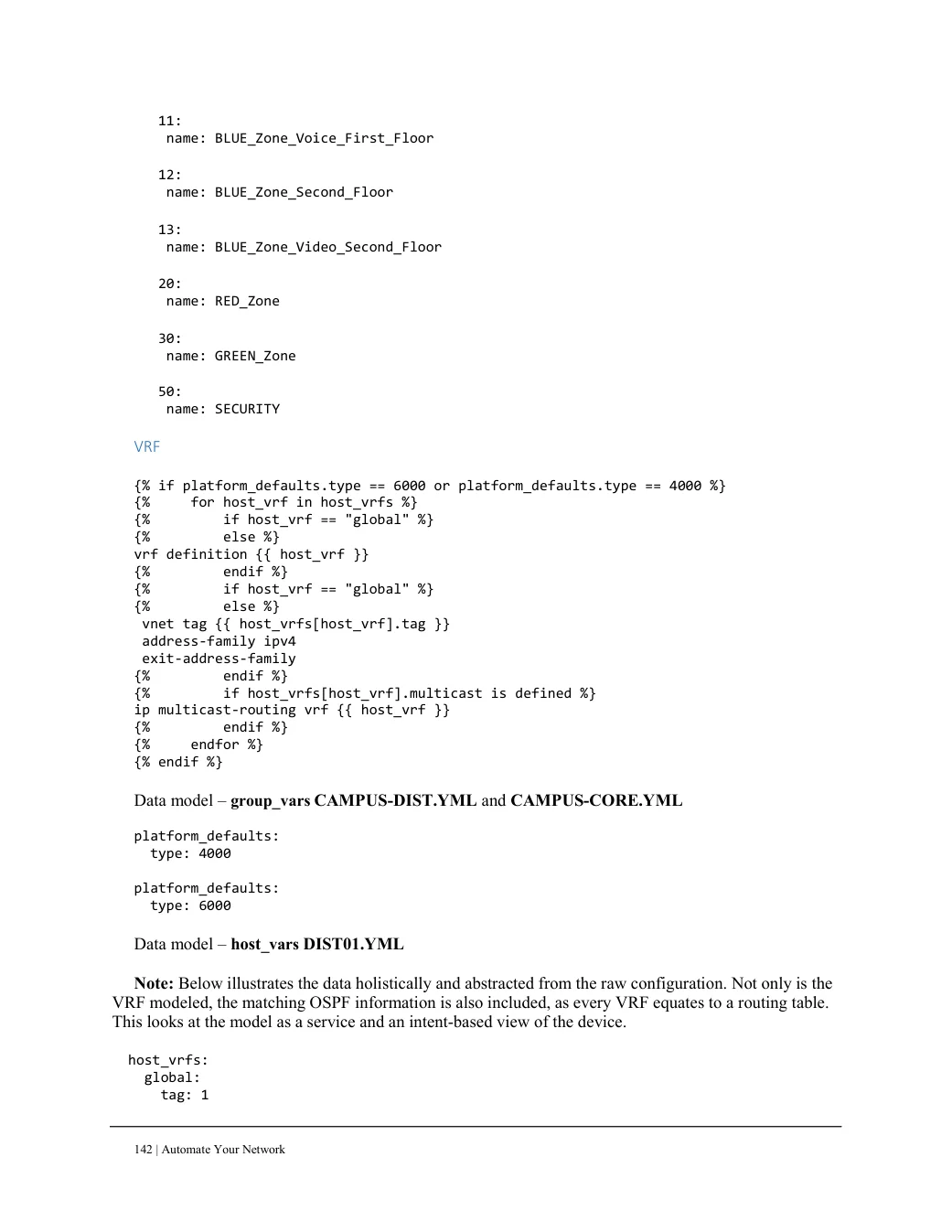
platform_defaults: type: 4000 platform_defaults: type: 6000 Data model – host_vars DIST01.YML Note: Below illustrates the data holistically and abstracted from the raw configuration. Not only is the VRF modeled, the matching OSPF information is also included, as every VRF equates to a routing table. This looks at the model as a service and an intent-based view of the device. host_vrfs: global: tag: 1