Chapter 8 Data Models and Dynamic Templates
For diagrams, tables, or exact code formatting, .
JOHN W. CAPOBIANCOPRINTED PAGE 152
TenGigabitEthernet2/1/16:

    Dist02:
      members:
        TenGigabitEthernet2/1/15:

        TenGigabitEthernet2/1/16:


  Port-channel100:
    port_channel: 100
    description: LegacyVLANs
    switchport: true
    switchport_mode: trunk
    lacp_mode: "active"
    Dist01:
      vlans: 100,200
      service_policy:
        input: QoS-IN-Legacy_VLANs
      members:
        TenGigabitEthernet1/1/13:

        TenGigabitEthernet2/1/13:

    Dist02:
      vlans: 100,200
      service_policy:
        input: QoS-IN-Legacy_VLANs
      members:
        TenGigabitEthernet1/1/13:

        TenGigabitEthernet2/1/13:

Host

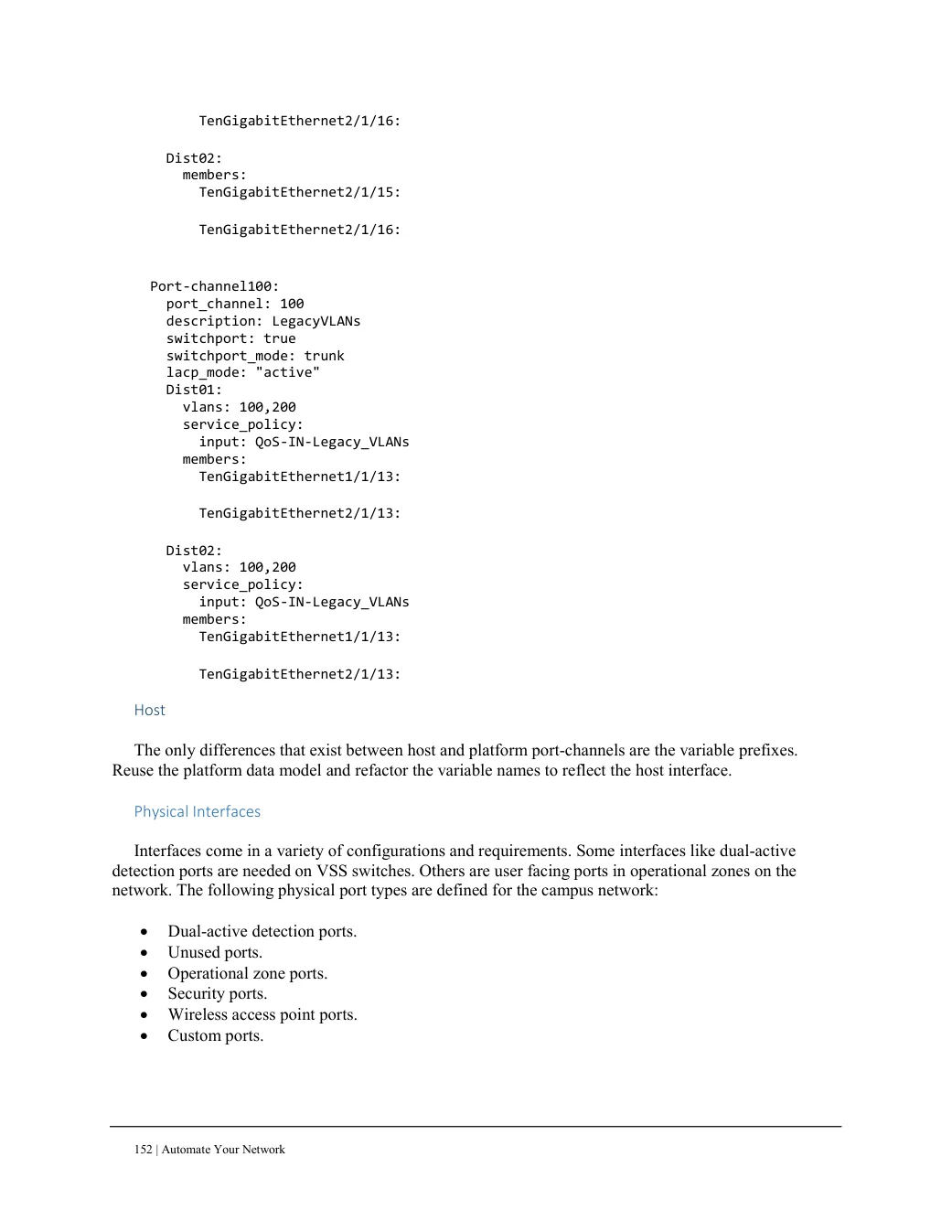
The only differences that exist between host and platform port-channels are the variable prefixes.
Reuse the platform data model and refactor the variable names to reflect the host interface.
Physical Interfaces Interfaces come in a variety of configurations and requirements. Some interfaces like dual-active detection ports are needed on VSS switches. Others are user facing ports in operational zones on the network. The following physical port types are defined for the campus network:
Dual-active detection ports. Unused ports. Operational zone ports. Security ports. Wireless access point ports. Custom ports.