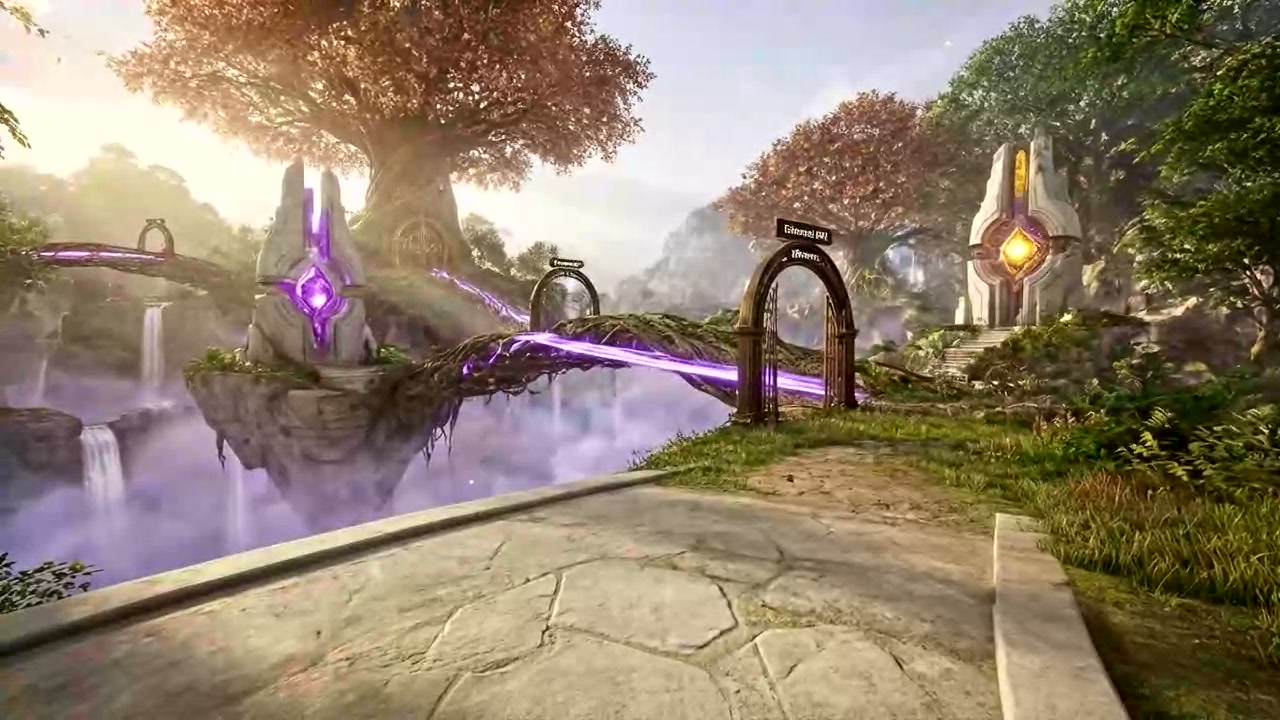
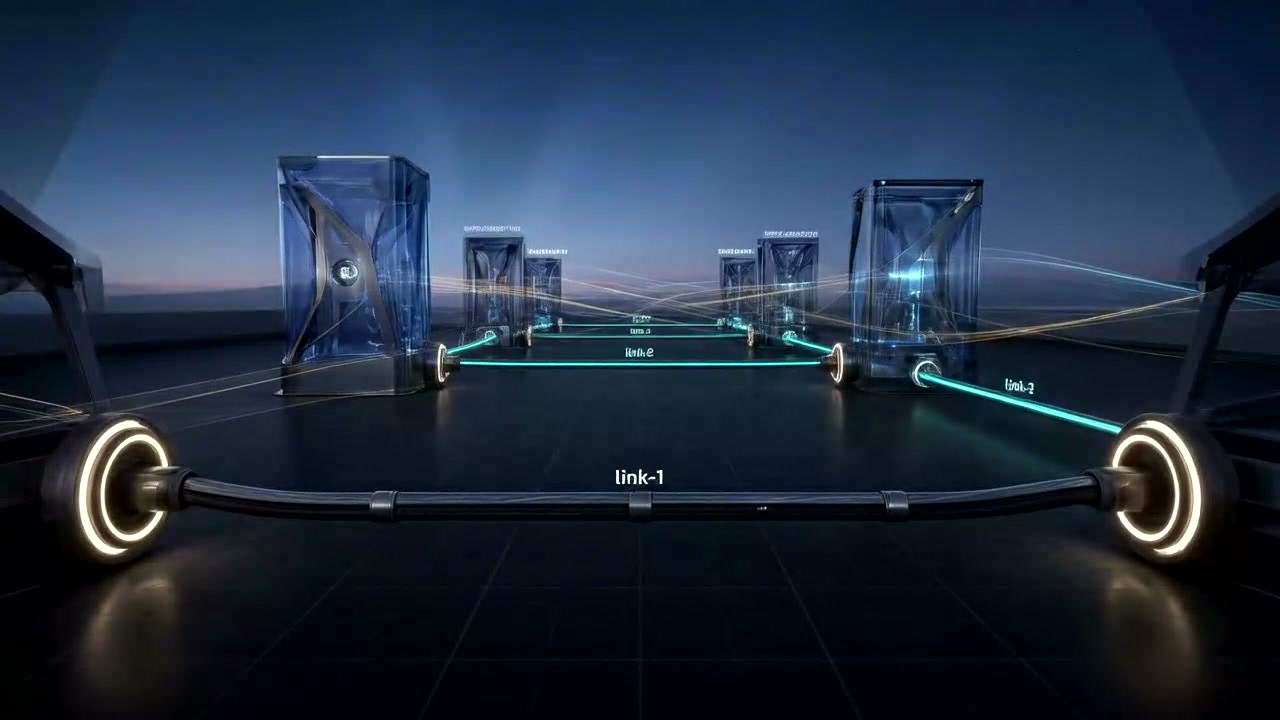
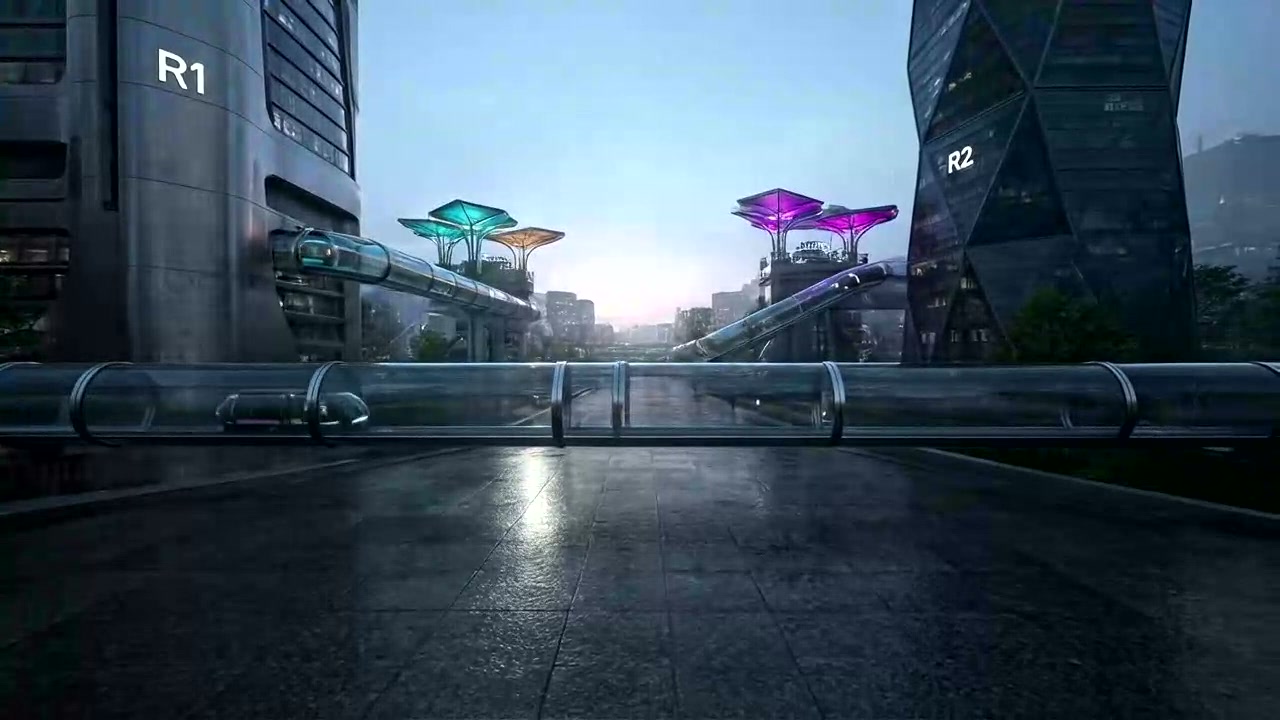
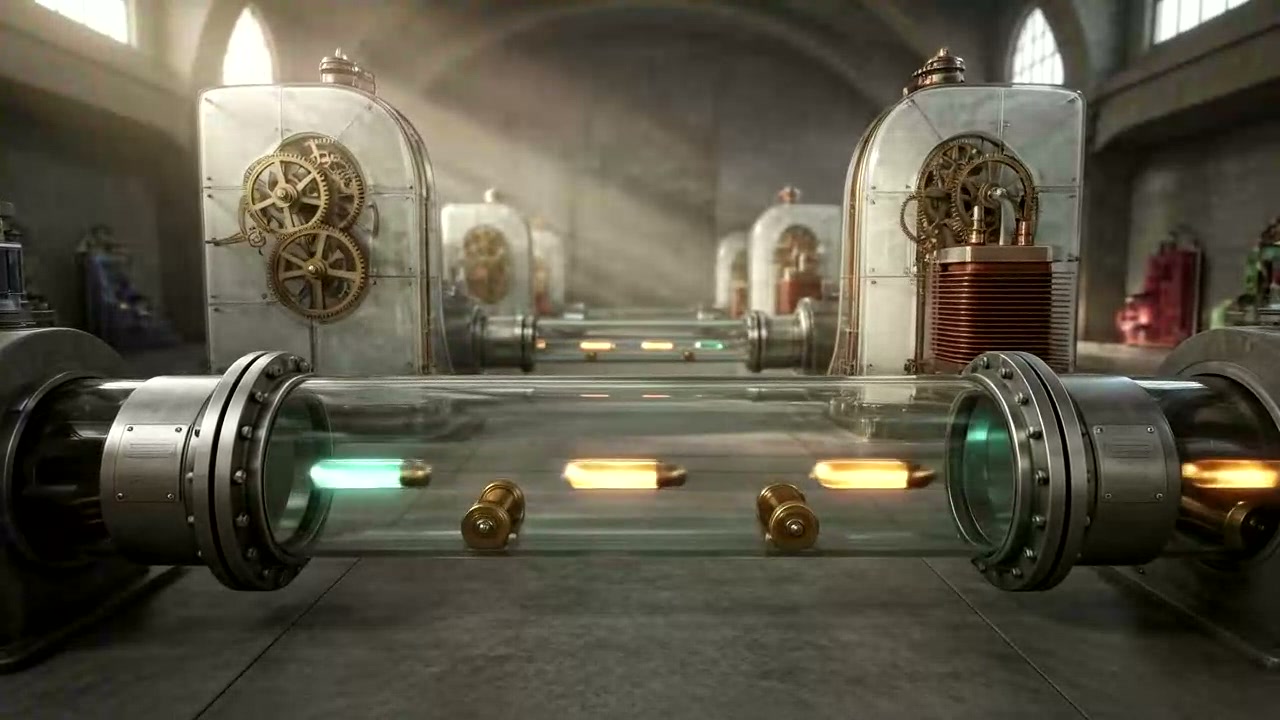
Actual Google-generated streams, recorded while navigating. Five fixed journeys. No live generation on this website.
FRAME FROM LIVING FANTASY GENERATED ILLUSTRATION
1frozen network
5visual interpretations
10 minof recorded journeys
0generation calls on playback
FIVE VIEWS OF THE SAME EVIDENCE
Pick a perspective. Press play.
Explore five recorded journeys inspired by the same real Cisco network. Each film is two minutes long, silent, and yours to pause, seek and replay. The route was chosen during recording.
The ambition has always been bigger than prettier diagrams: make the relationships in a network easier to think about, talk about and remember.
Our earlier NetClaw work brought network data into Blender and Unreal Engine. Local scenes give you geometry to inspect, editable objects and control over the presentation. They also bring an authoring environment: engines, assets, rendering and the hardware to run them.
That is a meaningful commitment. Both Blender’s recommended hardware and Epic’s Unreal guidance list 32 GB of RAM and 8 GB of graphics memory for their respective recommended Windows setups. Actual needs depend on the scene and workload.
For this experiment, we moved world generation to Google’s Genie 4 service. A paid-tier API key, an admitted budget and a controlled backend opened another path: turn a reviewed description into a stream we could navigate and record. The generation compute lives with the provider. The key stays on the backend.
What comes back is generated media. It does not give us an editable Blender scene, an Unreal project or a persistent game export. It does give us something powerful to share: five very different ways to imagine the same network, delivered here as ordinary videos.
MEASURE
Cisco pyATS Genie
Bounded collection. Retained observations. A frozen source of truth.
ORCHESTRATE
NetClaw
Reviewed projection. A scoped skill and six MCP tools. Budget and lifecycle controls.
IMAGINE
Google Genie 4
Generated video stream. Operator navigation. A recorded creative journey.
BUILT IN NETCLAW NOW
The skill gives the procedure. The MCP exposes the controls.
We wrote the netclaw-genie-worlds workflow skill to guide a bounded production: prepare the evidence, pin the reviewed projection and budget, admit the session, navigate, request the fictional lighting event, stop and inspect the evidence.
The thin execution MCP connects that procedure to the real Google service. A Node backend owns the credential, lifecycle worker, recording evidence and SQLite cost ledger. The browser receives media and sends navigation/event controls during production; it never receives the Google key.
genie_world_preparePin the evidence and reviewed projection
genie_world_startAdmit a session within its budget
genie_world_evidenceInspect retained production evidence
Implementation paths and what was actually qualified
The implementation is in scripts/genie-worlds/mcp_server.py, with registration at mcp-servers/genie-worlds-mcp/server.py. The workflow is workspace/skills/netclaw-genie-worlds/SKILL.md; its references/tools.md defines the contract. These are source-repository paths, not website downloads.
Admission pins source-file hashes, snapshot identity, exact projection hash and an explicit budget. Tools cannot accept arbitrary prompts, credential paths or export-approval booleans. The intended Risk member receives a backend control capability, not the Google key, device credentials or unrestricted snapshots. Native setup is intended to reuse supported NetClaw enrollment and policy mechanisms.
The first hosted qualification used an independent synthetic scenario. The five themed productions then used operator-pinned private-derived projections: reviewed core labels, measured data-port pairings, VLAN IDs and OSPF/iBGP relationships. Style and composition are fictional. Fifty source refinement passes preceded production; they were source changes and tests, not fifty paid world generations or a substitute for live acceptance.
A DIFFERENT COMPUTE MODEL
An API key. A bounded budget. A new perspective.
At the checked Standard rate, two minutes of video output is approximately US$12.10, before input and text-output charges. For this campaign, we conservatively reserved more per session.
Illustrative calculation, checked November 23, 2026: 120 seconds × 5,760 video tokens/second × US$17.50 per million = US$12.096. Google’s pricing and lifecycle guide. Recheck official terms, access and pricing before any new production.
CONSERVATIVE RESERVATION / SESSION
US$14.26
Exact reservation: US$14.258688 120-second video bound + maximum documented input/text bounds.
Five films + one synthetic qualification
6 sessions
Aggregate reservation, held pending billing
US$85.552128
Owner-authorized hard campaign limit
US$100
Google generation cost to replay here
US$0
Reserved budget is not billed usage. No final billing receipt was available. Ordinary hosting storage and bandwidth may still cost money.
The lifecycle lesson: closing a tab is not stopping a world
The backend owns deadlines and termination. Initial workers timed out waiting for terminal receipts and preserved unknown states. Reconciliation using the original provider IDs later recovered interaction.cancelled receipts for all six sessions, with no replacement worlds. These establish remote termination, not normal completed status or settled billing.
A temporary Google project spending-cap rate limit interrupted one reconciliation. Local admission refused the fifth world until the original session’s terminal receipt was recovered. The refused attempt created no provider session. The US$25 checkpoint was a review point within the US$100 limit, not permission to exceed it. All six full reservations remain held pending reconciliation.
Website visitors never invoke this lifecycle. Playback requires no Google API key, account login or generation backend.
THE SOURCE OF TRUTH
Keep one foot in the real network.
Every world starts with the same frozen evidence. The diagram and tables describe it. The generated scenery illustrates selected relationships.
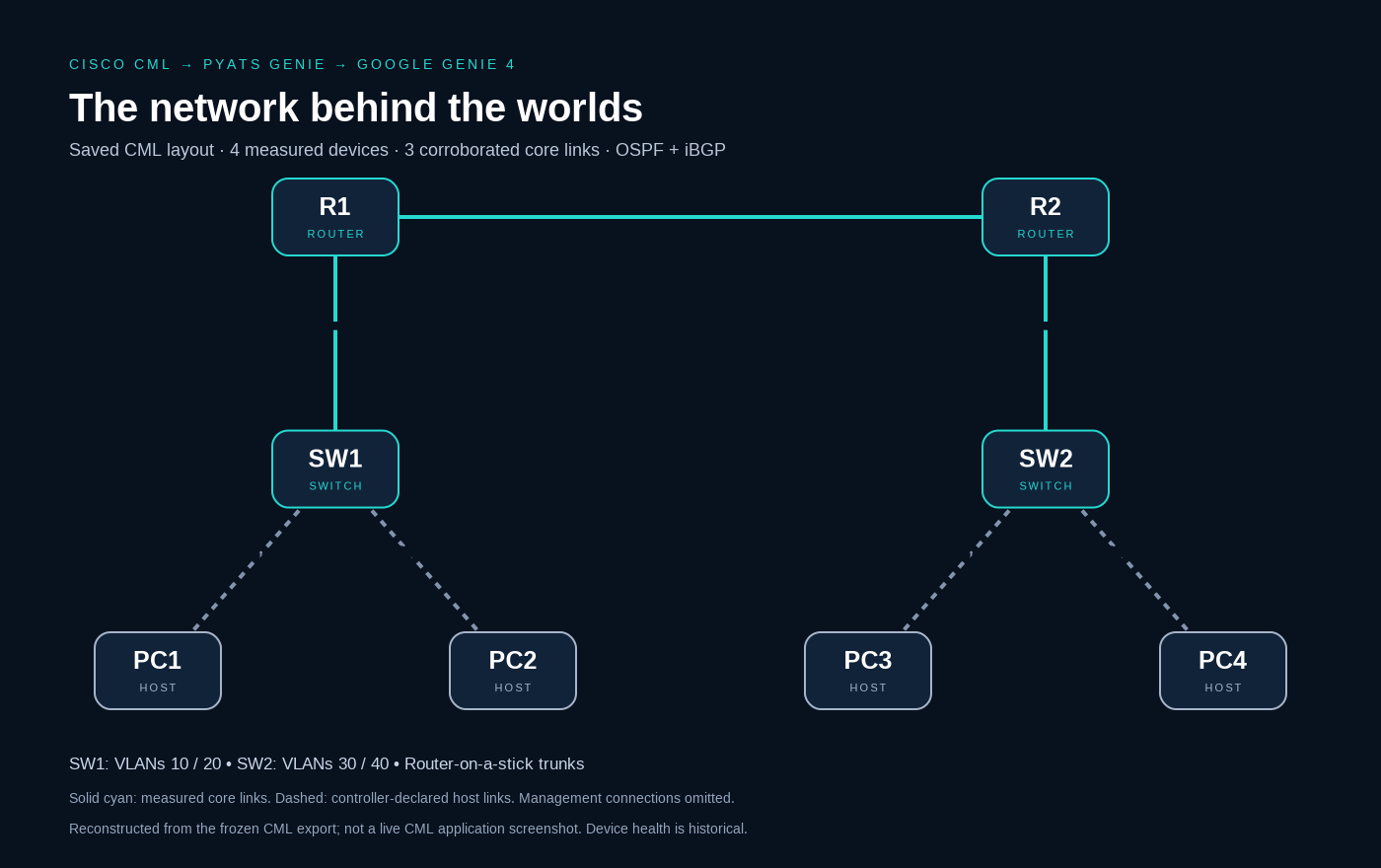
2D reconstruction from the saved Cisco CML topology and frozen network evidence.
This is a screenshot of our reconstructed diagram, not the native live CML application. Native screenshot access was unavailable during packaging.
Measured core linksController-declared host links
HISTORICAL SNAPSHOT · NOV 22, 2026
Four devices. Three measured links.
Corroborated data-port pairings
Device / port
Peer / port
R1 · Ethernet0/1
R2 · Ethernet0/1
R1 · Ethernet0/2
SW1 · Ethernet0/1
R2 · Ethernet0/2
SW2 · Ethernet0/1
R1–R2: /31 point-to-point link, OSPF underlay and loopback-based iBGP overlay. No static routes in the data network.
R1 + SW1VLANs 10 / 20
R2 + SW2VLANs 30 / 40
Router-on-stick gateways over trunk uplinks; switch Ethernet0/2 and Ethernet0/3 are access ports.
Inspect the host declarations, verification scope and capture inventory
Declared host links
SW1 Ethernet0/2 — PC1
SW1 Ethernet0/3 — PC2
SW2 Ethernet0/2 — PC3
SW2 Ethernet0/3 — PC4
Saved CML declarations, not four verified healthy hosts. Management connections are omitted.
Earlier lab verification
78 behavior checks and eight five-packet probes: 40/40 packets succeeded within the tested scope. That did not establish all-host reachability or current state. No device configuration changed during video production.
Capture inventory, with gaps
1,011 manifested files. Of 152 catalogued command entries, 120 were issued: 119 successful responses and one SW1 connection failure. The other 32 were unissued.
Parsing coverage: 100 parsed, 17 raw-only, two empty and 33 unavailable. These counts describe the inventory, not 152 successful measurements.
Rapid-PVST, appropriate edge PortFast/BPDU Guard, explicit allowed VLANs and disabled DTP were part of the retained configuration. CDP and LLDP ran on data ports; management interfaces were excluded and preserved.
How the evidence was collected
Bounded, role-specific pyATS operations and offline parsing covered identity; interfaces; CDP/LLDP neighbors; OSPF processes, adjacencies, interfaces and router LSAs; BGP summaries, neighbors, advertisements, routes and filters; routing tables and CEF; router-on-stick subinterfaces; VLANs, trunks and switchports; STP; error-disabled ports and counters; MAC/ARP and logs. Collection did not use unrestricted learn all. Source-addressed pings were separate active verification.
Running/startup configurations were retained locally for change audit. The maintainer command table is specs/200-genie-network-worlds/collection-commands.md in the source repository. Private arguments, raw output, configurations, addresses, credentials, raw counters and management topology are absent from this website.
A counter is not a rate without adequate timing and sample continuity. Moving lights in the videos are fictional; they are not driven by counters.
Frozen snapshot: November 22, 2026 · 23:49:04 UTC Recording package: November 23, 2026 · manifest and media hashes
A bridge can be a memory cue. A spatial layout can help you trace a relationship. Research gives us reasons to explore this—and reasons to design carefully.
Five real papers, five useful perspectives. These are controlled graph, recall and educational studies. They inspire this experiment; none validates these generated network worlds or proves that watching these films improves learning.
Ware & Franck1996ACM Transactions on Graphics
Follow the connections.
Head-coupled stereo viewing supported comprehension of graphs roughly three times larger than the study’s 2D condition.
A controlled graph-tracing task. A static perspective image alone may add little; the depth and motion cues mattered.
These files remain flat, prerecorded 16:9 video. They contain no stereo pair, 360° panorama or scene geometry. Moving your head cannot reveal a new view inside them, and a recording cannot accept a new route.
A future immersive version would need suitable immersive source media or an interactive spatial implementation, readable factual overlays, comfortable navigation and separate headset testing. That is a direction to investigate, not an enabled feature here.
Headset viewing is a possible approach; this prototype has not been qualified on a VR headset.
START WITH WHAT YOU CAN PROVE. SEE WHAT YOU CAN IMAGINE.
What would your network look like?
Watch a perspective. Follow a connection back to the evidence. Think about the story your own network could tell.