Nine NetClaw Borders Across AWS, Azure and Google Cloud

I entered a subnet calculation through a NetClaw Border on AWS. An execution member attached to the Azure group did the work. When I reloaded the dashboard in Chrome, it retrieved the original signed answer. The member’s execution counter stayed put. So did the model provider’s call count.
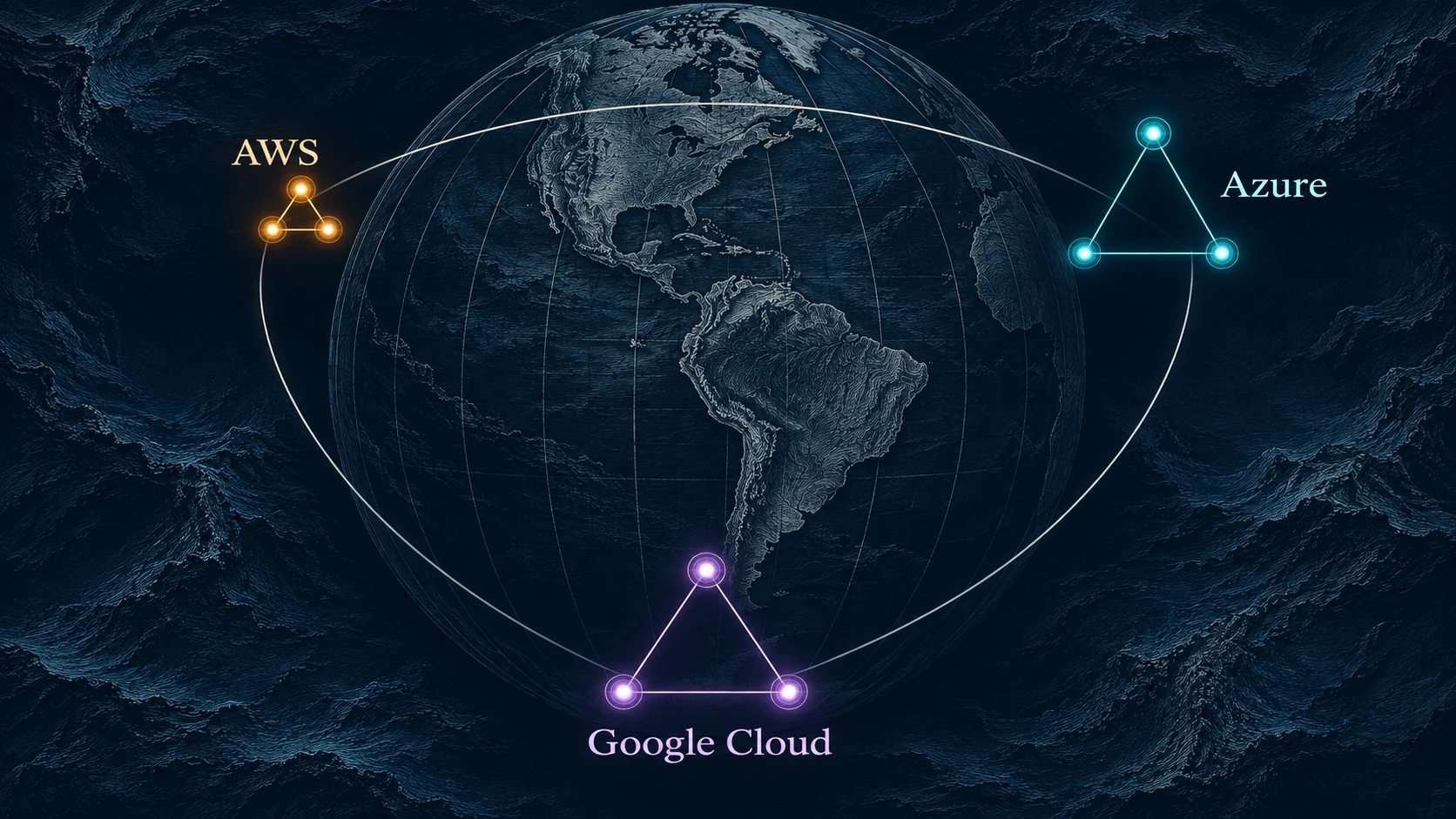
That was one of 27 paths I tested on November 26, 2026. Nine Borders ran across AWS, Microsoft Azure and Google Cloud. I used each Border as the front door for three tasks, one for each receiving group. All 27 returned a signed result and a durable acknowledgement. The subnet arithmetic was deliberately simple. The interesting question was who could authorize it when the front door and the worker belonged to different groups.
When the on-call team depends on NetClaw
I’m comfortable running a NetClaw on my laptop while I build a new skill. My expectations change the moment another engineer needs it to finish a shift. Imagine a maintenance window at 2 a.m. An engineer has approved a pre-change check. Their session drops before the answer comes back. The next person on call needs to know whether the check ran, which device answered and whether it is safe to proceed. If the only copy of that history is on the first engineer’s laptop, the team has to wake them up or repeat the work.
That is how I expect a NetClaw to become critical infrastructure. It starts with a team relying on it for something as ordinary as a device read. Once people use its answers to decide whether to continue a change, its availability matters during maintenance and outages alike. I want cloud hosting so the team can reach a shared Border independently of my machine. I want high availability (HA) so that when the machine hosting that Border is the one under maintenance, another can take responsibility and account for the work already approved.
What belongs in the cloud?
A Border authenticates an operator, presents work for approval and keeps track of the result. A member runs the approved tool under its own identity. A team can host its Borders in the cloud and keep a member close to the devices it manages. The member opens an outbound connection to its group. Its device credentials and access to the management network can stay on site.
An earlier hybrid test put that design to work. A Border in Montreal coordinated four separately approved reads. An on-premises Mac ran one show version over SSH on each of four Cisco Modeling Labs devices and returned the parsed IOS version. The cloud Border needed neither an SSH route into the lab nor the device credentials. Cloud hosting buys the team an independent place to reach NetClaw while preserving a useful choice about where its tools run. GCP hybrid test record
How three Borders share authority
Within each cloud, any of its three Borders can take an operator’s request. A follower forwards it to the current leader. The group keeps its authority record in etcd, a replicated store. Two of its three voters must agree to commit a decision. The leader holds a time-limited lease, and each period of leadership has a number called an epoch. Once a successor takes over, a returning leader’s old epoch can’t authorize the next tool call. HA authority design
Consider what happens if a member starts a tool call and the leader disappears before the operator sees a reply. Electing a successor tells us who may authorize the next operation. It says nothing about whether the first one ran. NetClaw keeps the original operation ID and records when the member consumes its single-use permission. The successor can look up the recorded outcome. If the evidence is incomplete, the operation stays marked uncertain and automatic redispatch is blocked. A dropped reply can leave a human with a question, but it cannot spend the same approval twice. Operation recovery contract
Placement affects how quickly a group can make those decisions. In the earlier Google Cloud lab, the median network round trip from Montreal to Belgium was about 107 milliseconds. From Belgium to Singapore it was about 330 milliseconds. After a leader change, the surviving pair may have the longest link. That is the pair I want to measure before promising an operator how long an approval will take. Regional measurements
Who approved the AWS-to-Azure task?
Federation connects three independently governed groups. Each group recognizes specific peers and grants them access to specific actions, members and tools. A member enrolls with one group. An Azure-only operation can proceed using Azure’s own quorum. When AWS sends a request across the mesh, Azure’s voters still decide what Azure will accept.
On the AWS-to-Azure path, the AWS Border authenticated me and signed a request to its Azure peer. Azure checked what it had granted that peer, recorded the operation in its own ledger and required approval there. Its member ran the subnet tool and signed the result. The receiving Border signed the acknowledgement, which the member recorded. I could follow the operation from the AWS dashboard while Azure retained control over its worker. Cross-cloud federation contract
Where the Borders and members ran
| Cloud group | Where the three Borders ran | What executed the final tasks |
|---|---|---|
| AWS | Three availability zones in the Ohio region (us-east-2) |
Three EC2-hosted members, one on each Border’s host |
| Microsoft Azure | Three distinct Azure regions | One Mac member enrolled with the Azure group |
| Google Cloud | Three distinct Google Cloud regions | One Mac member enrolled with the Google Cloud group |
All five members participated. A signature identified which member produced a result. To establish where the AWS members actually ran, I separately matched each member’s certificate and running process to its EC2 instance and availability zone. The AWS account permitted Ohio for this test, so AWS cross-region recovery remains an open question. AWS scope amendment
From one cloud to three
The work began on Google Cloud. In an earlier test, a request entered through Belgium and reached the leader in Montreal. The member calculated the usable addresses in 192.0.2.0/26 and returned 62, with a broadcast address of 192.0.2.63. That established that a follower could serve as the front door to its own group. GCP live test record · The original NetClaw on GCP article
Azure introduced a second authority. By November 24, all six Azure and Google Cloud Borders had handled both a local task and a task for the other group. In a separate test, a request entered through Azure and a member running on Google Cloud read a device record from NetBox. That earlier test established physical GCP execution. The November 26 matrix used fresh Mac members for the Azure and Google Cloud groups. Azure and Google Cloud acceptance record
AWS joined in stages. I started with one Ohio Border, then verified a member running on EC2. In a separate CPU-only Ollama test, the member processed 2001:db8::/64 in 53.512 seconds using two local model calls and one tool call. I retired the model before bringing up three AWS hosts. In that three-zone test, every AWS Border reached every AWS member. AWS verification history
Accounting for the 27 results
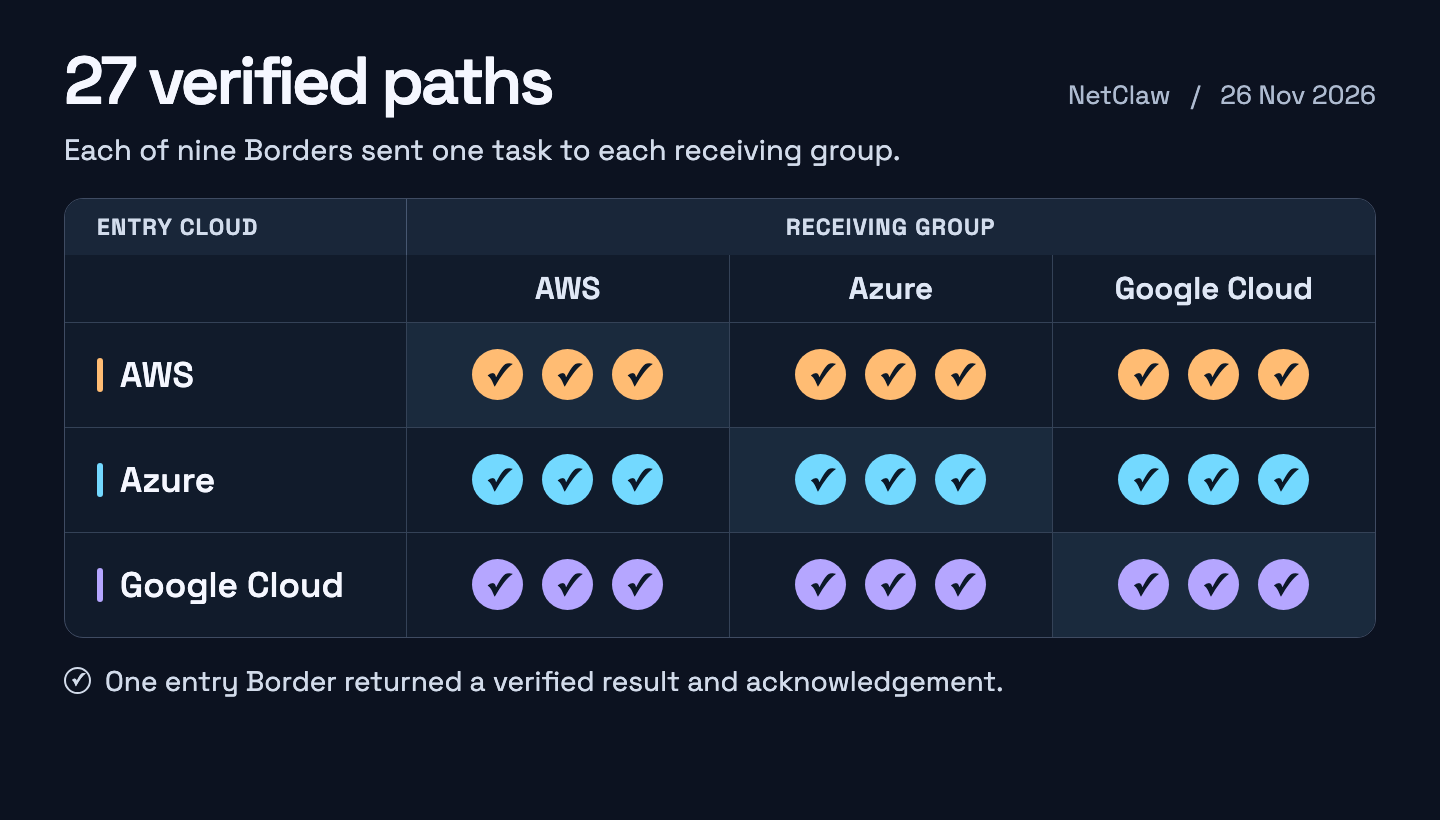
For the final run, each of the nine entry Borders sent one subnet task to each of the three groups. Member journals showed 27 acknowledged tool executions. Provider journals showed 54 completed hosted model calls, each succeeding on its first upstream attempt. Each model or tool call needed its own single-use authorization. That accounts for all 81 authorizations, each completed within its signed nine-second window. All 27 operation budgets settled. The workload exercised computational networking tools. Testing commands on physical routers and switches would require a different workload. Final acceptance record
What stayed available during a failure?
A Border leader stopped. In the AWS-only stage, I paused the leader in one Ohio zone and kept it paused. A Border in a second zone took over. From VS Code I approved a fresh task through that successor, and the member returned its signed result. The successor also recovered references to the nine earlier results. Full copies of every artifact produced by the previous leader remained outside that guarantee. This was a process failure. Recovery from the loss of an entire availability zone or AWS region still needs its own test. Ohio failover record
An operator reopened a client. The Chrome reload recovered the AWS-to-Azure operation in the same browser profile. I also tested the opposite direction. After a full VS Code relaunch with its saved profile, the extension retrieved the original Azure-to-AWS result. Both clients issued only read requests during recovery. Across all five members, the execution and provider counters held steady.
Then I stopped the guard workers and their watchdogs on all nine Borders. One fresh probe per cloud returned HTTP 408 with no fallback, and no member executed new work. In a separate fault test, I paused two of the three etcd voters in each group. All three groups refused to prepare a fresh operation. None issued an operation ID or an approval. Even a healthy peer in another cloud has no vote in the affected group and cannot take over its approvals. Recovery and fault results
For a team planning its own deployment, the member deserves a separate availability decision. The three Azure Borders in the final run all depended on one Mac for the subnet skill. If that Mac were offline, an operator could still reach the Borders, but that particular worker would be unavailable. The same question applies to a member’s route to a device or its model provider. I’d choose the checks the on-call team needs during an outage and test the loss of each dependency before committing to a recovery time.
Taking the lab down
Before teardown, I stopped the processes and verified 23 private archives containing 2,542 files. After teardown, repeated inventory checks accounted for all 83 removed cloud resources, including 39 on AWS and 44 across Azure and Google Cloud. The nine DNS names and their certificate-validation records were gone too.
With all 39 tasks complete, the ledger closed with conservative allocations of US$11.53 for AWS and US$9.00 for external costs. It retained reserves of US$5 and US$1 respectively. Final provider billing was still outstanding. The implementation merged into NetClaw’s main branch on November 26. Cleanup and cost record · Merged implementation and checks